Permanent Magnet Products

Table OF CONTENTS

1. Permanent Magnet Materials
2. NdFeB Rare Earth Magnets
3. Sm-Co Rare Earth Magnets
4. Alnico Magnets
5. Ceramic Magnets
6. Flexible & plastic Magnets
7. Reference Information

1. Permanent Magnet Materials

Permanent magnets are used in the following major groups: acoustic transducers, motors and generators, magneto mechanical devices, and magnetic field and imaging systems. You will find permanent magnets in many products, such as televisions, telephones, computers, audio systems and automobiles.

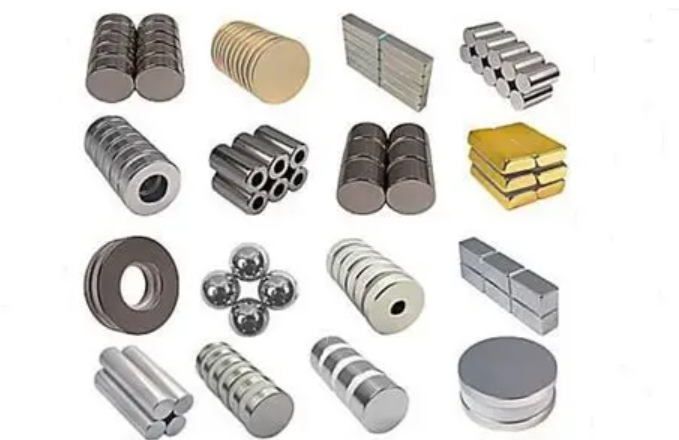
The permanent magnet family consists, in general terms, of non-rare earth permanent magnets and rare earth magnets. The non-rare earth magnets include Alnico (Aluminum-Nickel-Cobalt) magnets and Ceramic (Strontium and Barium Ferrite) magnets. Rare earth magnets include Sm-Co (Samarium-Cobalt) magnets and NdFeB (Neodymium-Iron-Boron) magnets.

Although non-rare earth magnets are used in the majority of these applications due to their economic cost, rare earth permanent magnets have many distinguishing characteristics, such as a larger Maximum Energy product, (one performance index for permanent magnets). Dozens of rare earth magnetic materials have been developed recently. The two major families of rare earth permanent magnets, SmCo magnets and NdFeB magnets, have been widely used in a variety of applications.
[Back to the beginning of this page]

2. NdFeB Magnets
NdFeB magnets have a higher Maximum Energy product, (BH)max, than Sm-Co magnets. (BH) max of NdFeB can easily reach 30 MGOe and even goes up to 48 MGOe. NdFeB magnets can replace Sm-Co magnets in most cases, especially where operating temperature is less than 80 degrees Centigrade. Both NdFeB and Sm-Co magnets can be made either into sintered or polymer-bonded magnets. The polymer (such as epoxy)-bonded magnets can be produced with tight tolerances, with little or no finishing required. Stamford Magnets supplies polymer-bonded NdFeB permanent magnets made by both compression moulding and injection moulding. The sintered magnets usually require some finishing operations in order to hold close mechanical tolerances. The sintered magnets, however, provide better magnetic properties than bonded magnets.

A: Sintered NdFeB Magnet properties

1. Use of sintered NdFeB permanent magnets made by non-licensee is prohibited by the patent Law of the United States of America. All sintered Neodymium-Iron-Boron (NdFeB) permanent magnets, which Stanford Magnets Company supplies, are licensed.

2. The grades listed are only a portion of the products we supply; please contact us for the grade you need

3. The datas listed are the typical properties, and the datas in parentheses are the minimum values

4. Some general properties: Density: 7.4 -7.6; Hardness: 600 {Hv}

Grade Br
(KGs)
Hc
(KOe)
Hci
(KOe)
(BH)max
(MGOe)
Curie Temp.
of Br
(oC)
Max. Op. Temp
(oC)
N28UH 10.2-10.8 >9.6 >25 26-29 350 180
N28EH 10.4-10.9 >9.8 >30 26-29 350 200
N30UH 10.8-11.3 >10.2 >25 28-31 350 180
N30EH 10.8-11.3 >10.2 >30 28-31 350 200
N33 11.3-11.7 >10.5 >12 31-33 310 80
N33H 11.3-11.7 >10.5 >17 31-34 320 120
N33SH 11.3-11.7 >10.6 >20 31-34 340 150
N33UH 11.3-11.7 >10.7 >25 31-34 350 180
N35 11.7-12.1 >10.9 >12 33-36 310 80
N35H 11.7-12.1 >10.9 >17 33-36 320 120
N35SH 11.7-12.1 >11.0 >20 33-36 340 150
N38 12.1-12.5 >11.3 >12 36-39 310 80
N38H 12.1-12.5 >11.3 >17 36-39 320 120
N38SH 12.1-12.5 >11.4 >20 36-39 340 150
N40 12.5-12.8 >11.6 >12 38-41 310 80
N40H 12.4-12.8 >11.6 >17 38-41 320 120
N40SH 12.4-12.8 >11.8 >20 38-41 340 150
N42 12.8-13.2 >11.6 >12 40-43 310 80
N42H 12.8-13.2 >12.0 >17 40-43 320 120
N45 13.2-13.8 >11.0 >12 43-46 310 80
N48 13.8-14.2 >10.5 >11 46-49 310 80

Sintered NdFeB Magnet

B: Properties of Polymer Bonded NdFeB Magnets by Compression Moulding

Note: 1. The grades listed are only a portion of the products we carry; please contact us for the grade you need
2. The data listed are the typical properties, and the data in parentheses are the minimum values
Grade Br
(KGs)
Hc
(KOe)
Hci
(KOe)
(BH)max
(MGOe)
Density
(g/cm3)
Recoil
perm.
Temp. Coeff.
of Br
(%/oC).
Max. Op. Temp
(oC)
BNp-6 5.2-6.0 3.8-4.5 8.0-10 5-7 5.3-5.8 1.15 -0.13 140
BNp-8 6.0-6.5 4.5-5.5 8.0-12 7-9 5.6-6.0 1.15 -0.13 140
BNp-10 6.5-7.0 4.5-5.8 8.0-12 9-10 5.8-6.1 1.22 -0.07 ~ -0.105 120
BNp-12 7.0-7.6 5.3-6.0 8.0-11 10-12 6.0-6.2 1.22 -0.13 130
BNp-8H 5.5-6.2 5.0-6.0 12-16 6-9 5.6-6.0 1.15 -0.07 ~ -0.105 120

Polymer Bonded NdFeB Magnets by Compression Moulding

C: Properties of Polymer Bonded NdFeB Magnets by Injection Moulding

Note:
1. The grades listed are only a portion of the products we supply; please contact us for the grade you need
2. The datas listed are the typical properties, and the datas in parentheses are the minimum values
Grade Br
(KGs)
Hc
(KOe)
Hci
(KOe)
(BH)max
(MGOe)
Density
(g/cm3)
Recoil
perm.
Temp. Coeff.
of Br
(%/oC).
BNI-2 2.0-4.0 1.5-3.0 7.0-9.0 0.8-3.0 3.5-4.0 1.25 -0.13
BNI-4 4.0-4.9 3.1-3.9 7.2-9.2 3.5-4.5 4.0-5.0 1.20 -0.10
BNI-6 4.9-5.7 3.9-4.8 8.0-10.0 5.2-7.0 5.0-5.5 1.20 -0.10
BNI-8 5.7-6.3 4.8-5.4 8.5-10.5 7.4-8.4 5.0-5.5 1.20 -0.10
BNI-8H 4.8-5.6 4.2-5.0 13-17 5.0-6.5 5.0-5.5 1.13 -0.15

Polymer Bonded NdFeB Magnets by Injection Moulding

[Back to the beginning of this page]

3. SmCo Magnets
Two common compositions of SmCo magnets are Sm1Co5 and Sm2Co17. Generally, the cost of Sm-Co magnets is higher than NdFeB magnets. As a big advantage, Sm-Co magnets can operate at higher temperatures up to 300 degrees Centigrade. Sm-Co magnets are widely used in applications in which higher operating temperature and higher corrosion and oxidation resistance are crucial.

A: Sintered SmCo Magnet properties

Note:
1. The grades listed are only a portion of the products we supply; please contact us for the grade you need
2. The datas listed are the typical properties, and the datas in parentheses are the minimum values
Sm1Co5
Grade Br
(KGs)
Hc
(KOe)
Hci
(KOe)
(BH)max
(MGOe)
Curie Temp.
(oC)
Max. Op. Temp
(oC)
Sm1Co5-18 >8.5 >7.8 >17 17-19 750 250
Sm1Co5-20 >9.0 >8.0 >17 19-22 750 250
Sm1Co5-24 >10.0 >8.5 >15 22-24 750 250
Sm1Co5-26 >10.2 >9.5 >15 24-26 750 250

Sintered SmCo Magnet

Sm2Co17
Grade Br
(KGs)
Hc
(KOe)
Hci
(KOe)
(BH)max
(MGOe)
Curie Temp.
(oC)
Max. Op. Temp
(oC)
Sm2Co17-24 >9.5 >8.0 >17 20-24 800 250
Sm2Co17-26 >10.5 >8.5 >17 24-26 800 250
Sm2Co17-28 >10.5 >9.5 >15 26-28 800 250
Sm2Co17-30 >10.8 >9.8 >12 28-30 800 250

Sintered SmCo Magnet

B: Bonded Sm-Co Magnet properties

Sm1Co5
Grade Br
(KGs)
Hc
(KOe)
Hci
(KOe)
(BH)max
(MGOe)
Curie Temp.
(oC)
Max. Op. Temp
(oC)
SCB6 4.5 (4.0) 4.0 (3.5) 11(10) 6 (4) 720 120
SCB8 5.5 (5.0) 4.5 (4.0) 11(10) 8 (6) 720 120

Bonded Sm-Co Magnet

Sm2Co17
Grade Br
(KGs)
Hc
(KOe)
Hci
(KOe)
(BH)max
(MGOe)
Curie Temp .
(oC)
Max. Op. Temp
(oC)
SCB10 6.5 (6.0) 5.2 (4.5) 11.0 (10.0) 10 (8) 720 120
SCB12L 8.0 (7.0) 4.5 (4.0) 6.0 (5.0) 12 (10) 720 120
SCB12 8.0 (7.0) 5.5 (5.0) 11.0 (10.0) 12 (10) 720 120

Bonded Sm-Co Magnet

[Back to the beginning of this page]

4. Alnico:
Alnico magnetic material is an alloy of aluminum-nickel-cobalt which possesses an excellent temperature stability and high residual induction . However, its low coercive force limits its applications in many cases. Casting and sintering are two major processes used to manufacture the Alnico magnets. Alnico magnets with complex shapes may be manufactured by casting. However, once the Alnico magnets are formed, it is difficult to machine or drill them due to the hard and brittle mechanical properties of Alnico.

A: Casted Al-Ni-Co Magnet properties

Note:
The grades listed are only a portion of the products we supply; please contact us for the grade you need.
Grade Material Br
(KGs)
Hc
(KOe)
Hci
(KOe)
(BH)max
(MGOe)
Curie Temp.
(oC)
Max. Op. Temp
(oC)
ANCI 1 Isotropic Cast Alnico1 7.2 0.47 0.48 1.4 860 540
ANCI 2 Isotropic Cast Alnico 2 7.5 0.56 0.58 1.7 860 540
ANCI 3 Isotropic Cast Alnico 5 7.0 0.48 0.50 1.35 860 540
ANCA 5 Anisotropic Cast Alnico 5 12.5 0.64 0.64 5.5 860 540
ANCA 5-7 Anisotropic Cast Alnico 5-7 13.5 0.74 0.74 7.5 860 540
ANCA 6 Anisotropic Cast Alnico 6 10.5 0.78 0.80 3.9 860 540
ANCA 8 Anisotropic Cast Alnico 8 8.2 1.65 1.65 5.3 860 540

Casted Al-Ni-Co Magnet

B: Sintered Al-Ni-Co Magnet properties

Note:
The grades listed are only a portion of the products we supply; please contact us for the grade you need.
Grade Material Br
(KGs)
Hc
(KOe)
Hci
(KOe)
(BH)max
(MGOe)
Curie Temp.
(oC)
Max. Op. Temp
(oC)
ANSI 2 Isotropic Sintered Alnico 2 7.1 0.55 0.55 1.4 860 540
ANSA 5 Anisotropic Sintered Alnico 5 10.8 0.60 0.60 3.8 860 540
ANSA 6 Anisotropic Sintered Alnico 6 9.4 0.79 0.80 2.9 860 540
ANSA 8 Anisotropic Sintered Alnico 8 7.2 1.50 1.69 4.0 860 540

Sintered Al-Ni-Co Magnet

[Back to the beginning of this page]

5. Ceramic (Hard Ferrite)
Ceramic magnets are composed of iron oxide, barium and strontium elements. This class of magnets has a higher magnetic flux density, higher coercive force, and higher resistance to demagnetization and oxidation compared to other non-rare earth permanent magnets. The biggest advantage of such magnets is their low cost, which makes the hard ferrite magnets very popular in many permanent magnet applications. Due to their ceramic nature, ferrite magnets are very hard and brittle. Special machining techniques must to be utilized for these magnets.

Ceramic (Hard Ferrite) permanent Magnets

Note:
The grades listed are only a portion of the products we supply; please contact us for the grade you need.
Grade Br
(KGs)
Hc
(KOe)
Hci
(KOe)
(BH)max
(MGOe)
Curie Temp.
(oC)
Max. Op. Temp
(oC)
Ceramic 1 2.2 1.86 3.25 1.10 450 300
Ceramic 5 3.8 2.4 2.5 1.1 450 300
Ceramic 7 3.4 3.25 4.0 2.75 450 300
Ceramic 8 3.85 2.95 3.20 3.5 450 300
Ceramic 10 4.2 2.95 3.05 4.2 450 300

Ceramic (Hard Ferrite) Permanent Magnets

[Back to the beginning of this page]

6. Flexible and plastic Magnets
Flexible magnets can be either isotropic and anisotropic. The anisotropic flexible magnets are made through extrusion or injection. Properties such as high elasticity, flexibility and machinability make these magnets a favorite option for many permanent magnet applications in industry and in home appliances.

Flexible permanent Magnets

Note:
1. The grades listed are only a portion of the products we carry; please contact us for the grade you need
2. The data listed are the typical properties, and the data in parentheses are the minimum values
3. Some general properties: Density: 3.6 g/cm3; Operating Temp.: -40 ~ 100 oC; Hardness (Shore) 45 - 50; Tensile Strength: 50 Kg.f/cm2
Grade Br
(KGs)
Hc
(KOe)
Hci
(KOe)
(BH)max
(MGOe)
Max. Op. Temp
(oC)
Standard 1.7 1.2 2.4 0.6 100
HF1 2.0 1.8 2.6 1.0 100
HF2 2.3 2.0 2.6 1.2 100
HF3 2.45 2.12 3.1 1.5 100
HF4 2.65 2.4 3.3 1.7 100

Flexible Permanent Magnets

[Back to the beginning of this page] 7. Reference Information

REFERENCE BOOKS

The following books may be helpful for you in designing and selecting permanent magnet materials.

1. Permanent Magnet Design and Application Handbook, by Lester R. Moskowitz; published by Krieger publishing Company, Malabar, Florida; ISBN 0-89464-768-7

2. Permanent Magnet Materials and Their Application, by Dr. peter Campbell

3. Standard Specifications for permanent Magnet Materials, published by Magnetic Materials producers Association; (312) 201-0101, (312) 201-0214 (fax)

4. permanent Magnet Guidelines, published by Magnetic Materials producers Association; (312) 201-0101, (312) 201-0214 (fax)

MEASUREMENT SYSTEMS

Unit Symbol cgs System SI System English System
Length L centimeter (cm) meter (m) inch (in)
Flux ø/øB maxwell weber (Wb) maxwell
Flux Density B gauss (G) Tesla (T) lines/in2
Magnetizing Force H Oersted (Oe) ampere turns/m (At/m) ampere turns/in (At/in)
Magnetomotive Force F gilbert (Gb) ampere turn (At) ampere turn (At)
Permeability in Air µ 1 4 pi x 10-7 3.192

CONVERSION TABLE

from cgs to SI from SI to cgs
1 Oe = 7.962 x 10 A/m 1 A/m = 1.256 x 10⁻²Oe
1 G = 1 x 10⁻⁴ T 1 T = 1 x 10 4G
1 Gb = 0.796 At 1 At = 1 .265 Gb
1 maxwell = 1 x 10 -8 Wb 1 Wb = 1 x 10 8 maxwell
1 G Oe = 7.962 x 10 -3 J/m3 1 J/m3 = 1.256 x 10² G Oe
[Back to the beginning of this page]