

How Magnets Are Used in Medicine
Magnets have come a long way. They're no longer just for diagnosis—they're now at the heart of treatment, surgery, and even cutting-edge fields like nanorobotics. And the potential is huge.
How Widely Are Magnets Used in Medicine?
Very widely. In fact, magnets are so important that modern medicine couldn't really function without them.
Magnets Are the Backbone of Medical Imaging
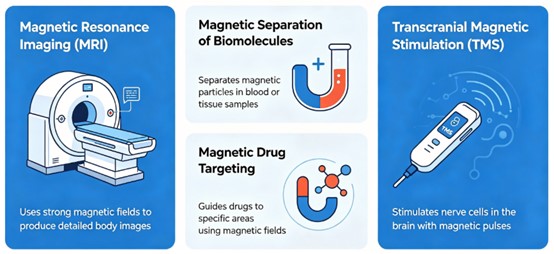
- MRI (Magnetic Resonance Imaging): This is the classic and most important use. MRI uses strong magnetic fields and radio waves to create high-resolution images of the inside of your body. It's a cornerstone of modern diagnosis.
- MPI (Magnetic Particle Imaging): A newer technology that directly detects magnetic nanoparticles injected into the body. It allows for super-sensitive cell tracking and targeted imaging.
- Better imaging contrast: Magnetic nanoparticles—especially SPIONs (superparamagnetic iron oxide nanoparticles)—are used as contrast agents in MRI to significantly improve diagnostic accuracy.
Magnets Enable Non-Invasive and Precision Treatments
- TMS (Transcranial Magnetic Stimulation): This is a completely non-invasive neuromodulation technique. It uses magnetic fields to stimulate specific areas of the brain. TMS is used to treat depression, anxiety, insomnia, and is also widely used in stroke recovery.
- MHT (Magnetic Hyperthermia): A cutting-edge cancer treatment. Magnetic nanoparticles are delivered into a tumor, and an external alternating magnetic field heats them up to 42–46°C. That heat "cooks" the cancer cells with very little damage to healthy tissue.
- Targeted drug delivery: Drugs are loaded into magnetic carriers, and an external magnetic field guides them to the disease site before release. This boosts the drug concentration where it's needed and reduces side effects elsewhere. The Suzhou Institute of the Chinese Academy of Sciences has developed a liver cancer targeting system that achieves 90% drug accumulation in the tumor.
- Magnetically controlled microrobots: This is one of the fastest-growing areas. These tiny robots, about the size of a grain of sand, are controlled by magnets and can navigate precisely inside the body to deliver drugs. A team at ETH Zurich has already achieved over 95% precision in drug delivery in animal studies.
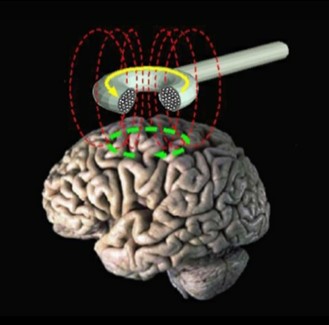
Transcranial Magnetic Stimulation[1]
Magnets Are Powerful Surgical Assistants
- Changing minimally invasive surgery: Using magnetic force instead of traditional instruments means smaller incisions, less pain, and faster recovery. The FDA has already approved a magnetic minimally invasive surgical robot platform.
- Magnetic anchoring and traction: In laparoscopic surgery, magnets outside the body attract magnetic instruments inside the body to pull tissue out of the way. This reduces the number of abdominal incisions needed.
- Magnetic anastomosis: Two magnets attract each other across tissue, compressing it until it heals and forms a connection. This is especially useful in complex surgeries like digestive tract reconstruction. Some call it "smart anastomosis."
- Removing foreign objects: Rare earth magnets can be used to remove metal objects that accidentally get into the body—minimally invasively. This is especially helpful for children.
What Kinds of Magnets Make All This Possible?
After reading about all these medical applications, you might be wondering: what actual magnet products are behind them? The core materials fall into three main categories: permanent magnets, soft magnetic materials, and magnetic nanomaterials.
Permanent Magnets
These stay magnetized for a long time after being magnetized. They're the heart of MRI machines and magnetic surgical instruments.
- Neodymium (NdFeB): This is the most widely used third-generation rare earth permanent magnet. It has an extremely high energy product—it can lift 640 times its own weight. That lets medical devices be smaller and lighter. Magnetic anastomosis rings and magnetic anchoring surgical tools also rely heavily on NdFeB.
- Samarium Cobalt (SmCo): Another common permanent magnet. Its biggest advantages are excellent thermal stability and corrosion resistance. It also has naturally better biocompatibility. SmCo is the go-to choice for surgical instruments that need high-temperature steam sterilization, and for high-end MRI machines that demand extreme magnetic field stability.
- Alnico (Aluminum-Nickel-Cobalt): These magnets work fine at temperatures above 500°C, and their magnetic properties don't degrade much over time. They're often used in high-precision motors and servomotors in medical equipment.
Soft Magnetic Materials
These materials efficiently guide and amplify magnetic fields. They're the core of TMS devices and electromagnetic navigation systems.
- Electrical pure iron, silicon steel sheets, and iron-based amorphous materials are used in TMS cores to boost stimulation depth and precision.
- Superconducting materials—like niobium-titanium alloys and magnesium diboride—generate stable, strong magnetic fields at extremely low temperatures. They're what make MRI and precision drug release systems possible.
Magnetic Nanomaterials
These nanoscale materials use "superparamagnetism" to achieve precise control.
- SPIONs (superparamagnetic iron oxide nanoparticles) are the core of MRI contrast agents and magnetic hyperthermia.
- Gadolinium-based contrast agents are used for enhanced imaging.
- Neodymium nanoparticles drive magnetically controlled microrobots for targeted drug delivery.
- Magnetic surgery kits (like magnetic anastomosis devices) are made from high-energy-product neodymium and can safely contact human tissue.
Standard Magnets offers standard and custom permanent magnets. Not sure what you need? Check out our guide to find the right magnet for the job. View Guide