

Neodymium Magnet Grades Compared: N35 to N54 – What's the Difference?
Neodymium (NdFeB) permanent magnets are the strongest permanent magnets out there. This guide focuses on the standard N-series (regular temperature grade) and compares nine popular grades from N35 all the way up to N54.
Key Performance Parameters – What They Mean
Before we jump into the comparison table, let's quickly go over what these specs actually mean.
|
Parameter |
Symbol |
Unit |
What It Means |
|
Remanence |
Br |
mT / T / kGs |
Higher number = stronger magnet on its own |
|
Coercivity |
bHc / Hcb |
kA/m / kOe |
How well the magnet resists being demagnetized by outside forces |
|
Intrinsic Coercivity |
iHc / Hcj |
kA/m / kOe |
How well the magnet handles heat |
|
Max. Energy Product |
(BH)max |
kJ/m³ / MGOe |
The key measure of total magnetic energy density the magnet can store |
|
Squareness |
Hk / iHc |
% |
Closer to 100% = more stable magnetic performance |
|
Working Temp |
Tw |
°C |
Above this temp, magnetic strength may drop permanently |
Note: Working temperature is the max temp at which open-circuit flux irreversible loss is ≤5%, measured from a baseline of 20°C ± 2°C.
Performance Comparison Table: N35, N38, N40, N42, N45, N48, N50, N52, N54
Here's a full comparison of nine mainstream N-series grades, based on the GB/T 13560-2017 standard and industry data.
|
Grade |
Remanence |
Coercivity |
Intrinsic Coercivity |
Max. Energy Product |
Squareness |
Working Temp |
||||
|
mT |
kGs |
kA/m |
kOe |
kA/m |
kOe |
kJ/m³ |
MGOe |
% |
°C |
|
|
N35 |
1170–1210 |
11.7–12.1 |
≥868 |
≥10.9 |
≥955 |
≥12.0 |
263–287 |
33–36 |
95–98 |
80 |
|
N38 |
1210–1250 |
12.1–12.5 |
≥899 |
≥11.3 |
≥955 |
≥12.0 |
287–310 |
36–39 |
95–98 |
80 |
|
N40 |
1250–1280 |
12.5–12.8 |
≥923 |
≥11.6 |
≥955 |
≥12.0 |
318–342 |
38–41 |
95–98 |
80 |
|
N42 |
1280–1320 |
12.8–13.2 |
≥923 |
≥11.6 |
≥955 |
≥12.0 |
318–342 |
38–41 |
95–98 |
80 |
|
N45 |
1320–1380 |
13.2–13.8 |
≥876 |
≥11.0 |
≥955 |
≥12.0 |
342–366 |
43–46 |
95–98 |
80 |
|
N48 |
1380–1420 |
13.8–14.2 |
≥835 |
≥10.5 |
≥876 |
≥11.0 |
366–390 |
46–49 |
95–98 |
80 |
|
N50 |
1390–1440 |
13.9–14.4 |
≥796 |
≥10.0 |
≥876 |
≥11.0 |
390–422 |
49–53 |
95–98 |
80 |
|
N52 |
1420–1460 |
14.2–14.6 |
≥795 |
≥10.0 |
≥876 |
≥11.0 |
406–430 |
51–54 |
95–98 |
80 |
|
N54 |
1450–1500 |
14.5–15.0 |
≥795 |
≥10.0 |
≥876 |
≥11.0 |
430–455 |
54–57 |
95–98 |
80 |
Note: Numbers can vary a bit between manufacturers. Always check the actual test report from your supplier.
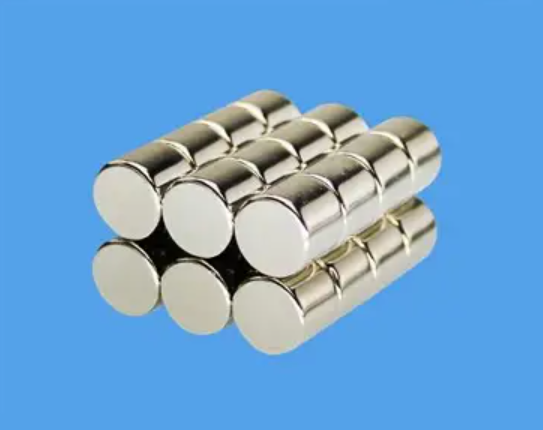
Stanford Magnets offers neodymium magnets in sizes from 0.010" to large assemblies, with standard shapes like discs, blocks, rings, and arc segments. Custom shapes can be made to your specs. Custom Neodymium Magnets.
FAQ
Q1: Does a higher grade always mean stronger magnetism?
Yes and no.
The grade number directly corresponds to the nominal max energy product, so a higher-grade magnet like N52 will have stronger pull force than a lower-grade like N35 at the same size. In theory, N52 magnet is about 50–57% stronger than N35. But here's the catch: higher-grade magnets actually have lower coercivity, meaning they're a bit easier to demagnetize than N35. So don't just chase the highest number—think about your application and whether demagnetization is a risk.
Q2: Why do N40 and N42 show the same max energy product range?
In the standard data, both N40 and N42 show the same (BH)max range of 318–342 kJ/m³ (38–41 MGOe). But N42 has a higher remanence ceiling (1320 mT vs. 1280 mT for N40). That just shows how complex magnet performance is—different parameters trade off against each other. Even though N42 has higher Br, its (BH)max doesn't increase linearly. That's due to factors like manufacturing process, grain alignment, and density. In real-world use, look at all the specs, not just the grade number.
Q3: Can N-series magnets be used above 80°C?
Not recommended.
N-series magnets have a max working temperature of 80°C. Go above that, and irreversible flux loss exceeds 5%—meaning the magnet permanently loses some of its strength, and cooling it back down won't help. If you need higher temperature operation, step up to these heat-resistant grades:
- 100°C → M series (e.g., N35M, N42M)
- 120°C → H series (e.g., N35H, N42H)
- 150°C → SH series (e.g., N35SH, N42SH)
- 180°C → UH series
- 200°C → EH/AH series
Q4: What does squareness (Hk/iHc) mean, and why does it matter?
Squareness is a measure of how "rectangular" the demagnetization curve looks. It's calculated as:
Squareness = Hk / iHc × 100%
Hk is the reverse magnetic field strength at which the magnetic polarization J drops to 90% of the remanence Jr.
Why it matters:
- Squareness closer to 100% means a more rectangular curve, more stable performance, better demagnetization behavior, and better consistency across production batches.
- For the same Br, higher squareness gives you higher (BH)max.
- Magnets with low squareness tend to hit their "knee point" earlier when exposed to reverse magnetic fields, so the usable energy product ends up lower than the rated value.
Higher-grade magnets push the limits of energy product, so controlling squareness gets harder. That's why high grades usually have slightly lower squareness than mid or low grades.
Q5: How do I pick the right grade for my application?
|
Application |
Recommended Grades |
Why |
|
Consumer electronics (speakers, headphones, vibration motors) |
N35–N42 |
Good value, plenty of performance |
|
Industrial motors / sensors |
N38–N48 |
Need decent magnetic strength in limited space |
|
EV drive motors |
N45–N52 |
High energy product, need to save space and weight |
|
Wind turbines / industrial automation |
N45–N50 |
High strength needed, stable operating environment |
|
High-end devices with tight space constraints |
N52–N54 |
Chasing maximum strength in extremely limited space |
|
High-temperature environments |
Use heat-resistant series |
N-series won't cut it above 80°C |
Q6: Is N54 the highest-grade neodymium magnet available today?
N54 is one of the highest commercially available regular grades out there. Its max energy product hits 54–57 MGOe, with remanence as high as 14.5–15.0 kGs—that's about 2–3% stronger than N52. Some manufacturers can push even higher, close to 55 MGOe. But in real-world applications, N54 is way more expensive than N52. It's also harder to machine, more brittle, and more prone to oxidation. Unless you're absolutely starving for space, N52 is usually the smarter, more cost-effective choice.
Bottom Line
The N35 through N54 series gives you a full range of options—from budget-friendly to ultra-high-performance neodymium magnets. When you're designing a real product, don't just look at the grade number. Check the actual test reports and demagnetization curves from your supplier, and consider magnet strength, heat stability, demagnetization resistance, and cost all together. That's how you'll find the right grade for the job.
References: