

Common Types of Magnetic Separation Equipment
Magnetic separation equipment is widely used to remove ferrous and weakly magnetic materials from bulk solids, slurries, and recycled streams. Different separator designs are optimized for particle size, magnetic susceptibility, throughput, and operating environment. The following sections describe the most common types used in industry today.
Drum Magnetic Separators
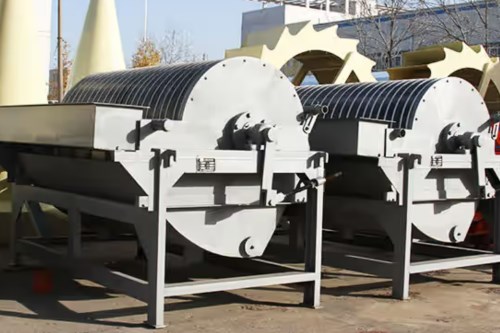
Drum magnetic separators are the most widely used magnetic separators in mineral processing and bulk material handling.
These separators consist of a rotating cylindrical drum with a stationary magnetic system inside. As material flows over the drum surface, magnetic particles are attracted and held against the drum, while non-magnetic material falls freely. The rotation then carries the captured magnetic material to a discharge zone where it is released.
Drum separators are available in dry and wet configurations and can be fitted with either low-intensity ferrite magnets or high-intensity rare-earth magnets, depending on the application. They are commonly used for removing tramp iron from crushed ores, coal, sand, and aggregates, as well as for concentrating magnetite in iron ore processing.
Because of their simple design, continuous operation, and high reliability, drum magnetic separators are a standard choice for primary magnetic separation stages.
High-Gradient Magnetic Separators (HGMS)
High-gradient magnetic separators are designed for the separation of weakly magnetic and very fine particles.
Unlike conventional drum separators, HGMS systems generate extremely high magnetic field gradients by passing material through a matrix of fine steel wool or grooved plates placed inside a strong magnetic field. This configuration creates localized zones of very high magnetic force that can capture paramagnetic minerals and ultrafine particles that would otherwise escape separation.
HGMS units are widely used in the beneficiation of hematite, ilmenite, wolframite, and rare-earth ores, as well as in kaolin clay purification and wastewater treatment. They are especially valuable when particle sizes fall below 50 micrometers or when magnetic susceptibility is very low.
Although more complex and energy-intensive than conventional separators, HGMS systems provide unmatched performance in fine-particle and weakly magnetic separations.
Magnetic Pulleys and Overband Magnets in Bulk Material Handling
Magnetic pulleys and overband magnets are essential for protecting conveyors and downstream equipment in bulk material systems.
A magnetic pulley replaces the head pulley of a conveyor belt and automatically separates ferrous material as the belt discharges. Magnetic items are held against the belt and carried around the pulley, while non-magnetic material follows a normal discharge trajectory.
An overband magnet, also known as a suspended magnet, is installed above conveyor belts and removes tramp iron from moving material streams. These units may be permanent magnets or electromagnets and can operate with self-cleaning belts or manual cleaning systems.
These devices are widely used in mining, cement plants, steel mills, power stations, and recycling facilities. Their primary function is not concentration but equipment protection and contamination control, preventing damage to crushers, mills, and screens while improving product quality.
Eddy Current Separators for Non-Ferrous Metal Recovery
Eddy current separators are specialized systems designed for separating non-ferrous metals from non-metallic materials.
Instead of using static magnetic attraction, these separators rely on a rapidly rotating magnetic rotor that induces eddy currents in conductive non-ferrous metals such as aluminum, copper, and brass. The induced currents generate opposing magnetic fields, creating a repulsive force that ejects the metal particles from the material stream.
Eddy current separators are widely used in recycling and waste management, particularly for processing shredded electronic waste, automotive scrap, packaging waste, and municipal solid waste. They play a critical role in recovering valuable non-ferrous metals and improving recycling efficiency.
Because they do not affect ferrous metals or non-conductive materials, eddy current separators are usually installed after conventional magnetic separators in multi-stage separation systems.
Plate Magnets, Grate Magnets, and Magnetic Traps in Process Lines
Plate magnets, grate magnets, and magnetic traps are designed for removing fine ferrous contamination in enclosed process streams.
Plate magnets are flat magnetic assemblies mounted inside chutes or ducts, where they attract and hold iron particles from gravity-fed material flows.
Grate magnets, also known as magnetic grids, consist of multiple magnetic bars arranged in a grid pattern and installed inside hoppers, bins, or pipelines. As material passes through the grid, ferrous contaminants are captured on the bar surfaces.
Magnetic traps are sealed housings containing magnetic elements, typically used in liquid or slurry pipelines to remove fine iron particles from process fluids.
These devices are commonly used in food processing, pharmaceuticals, plastics, ceramics, and chemical production, where even trace metal contamination can damage equipment or compromise product quality. Their compact size, simple installation, and high capture efficiency make them ideal for inline protection and quality control.
Wet vs. Dry Magnetic Separators
Wet and dry magnetic separators differ primarily in operating environment and material handling conditions.
Dry magnetic separators process materials in air and are typically used for coarse particles, free-flowing powders, and low-moisture feeds. They are widely applied in coal processing, dry iron ore beneficiation, recycling, and bulk material protection systems. Dry separators are easier to maintain and require no water management but may have lower efficiency for fine or sticky materials.
Wet magnetic separators operate with slurry feeds and are designed for fine particles and high-capacity mineral processing circuits. They provide better dispersion of particles, improved selectivity, and higher recovery rates for fine magnetic minerals. Wet drum separators are commonly used in magnetite concentration, heavy media recovery, and mineral beneficiation plants.
The choice between wet and dry systems depends on particle size, moisture content, throughput, and downstream process requirements.
Summary Table
|
Equipment Type |
Separation Principle |
Typical Particle Size |
Main Applications |
Key Advantages |
|
Drum Magnetic Separator |
Attraction of magnetic particles to rotating drum |
Coarse to medium |
Iron ore, coal, aggregates, tramp iron removal |
Simple design, high throughput, continuous operation |
|
High-Gradient Magnetic Separator (HGMS) |
High field gradients capture weakly magnetic fine particles |
Fine to ultrafine (<50 µm) |
Hematite, rare earths, kaolin, wastewater |
Excellent recovery of weakly magnetic materials |
|
Magnetic Pulley / Overband Magnet |
Permanent or electromagnetic attraction on conveyors |
Coarse bulk material |
Mining, cement, recycling, power plants |
Equipment protection, automatic operation |
|
Eddy Current Separator |
Induced eddy currents repel conductive non-ferrous metals |
Medium to coarse |
Aluminum, copper recovery in recycling |
Efficient non-ferrous metal recovery |
|
Plate / Grate Magnets / Traps |
Direct capture of ferrous contaminants |
Fine powders, liquids |
Food, pharma, plastics, ceramics |
High purity, compact design, easy installation |
|
Wet Magnetic Separator |
Magnetic attraction in slurry medium |
Fine particles |
Magnetite concentration, heavy media recovery |
High recovery, good selectivity |
|
Dry Magnetic Separator |
Magnetic attraction in air |
Coarse particles |
Coal, dry ores, recycling |
Simple operation, no water handling |
For more information, please check Stanford Magnets.