

Something to Know about Teflon (PTFE) Encased Magnets
Teflon (PTFE) coatings have become a critical innovation for safeguarding permanent magnets against corrosion, chemicals, and wear in demanding environments. The use of both PTFE-coated and fully PTFE-encased magnets is rapidly expanding across industries. This essay will explore their distinct characteristics and applications.
Teflon (PTFE) Coatings and Permanent Magnets
Teflon, otherwise known as PTFE, is a versatile material widely used, highly valued for its resistance to chemicals, non-sticking properties, and stability at elevated temperatures. These properties make PTFE an ideal candidate in protecting sensitive components, including magnets, in various applications.
Permanent magnets are often created from ferrite, neodymium-iron-boron, or samarium-cobalt. These materials possess permanent magnetic properties, naturally holding their magnetism and requiring no electrical power. Permanent magnets may, however, degrade over time by exposure to moisture, chemicals, or extreme heat. High-build PTFE coatings on the magnet surface add another layer of protection against these elements. However, while PTFE coatings provide excellent protection against surface wear, they do not offer complete encapsulation, which can be crucial in certain applications.
Teflon (PTFE) Coated Magnets vs Teflon (PTFE) Encased Magnets
While similar-sounding, the terms "Teflon-coated magnets" and "Teflon-encased magnets" are, in fact, very different. The difference between them concerns mainly the processes of setting these magnets into their shapes and the level of protection afforded by the Teflon material.
Teflon-Coated Magnets
As already noted, Teflon-coated magnets are normally coated with a thin layer through some processes such as powder coating or electrostatic spraying. Such a layer clings to the magnet surface, thus protecting it from corrosion, chemicals, and wear. Still, at the core, the magnet is exposed; thus, though it has an insulating outer layer, it remains susceptible to very harsh conditions in certain uses.
Teflon-Encased Magnets:
By contrast, in Teflon-encased magnets, the magnet would be fully enclosed in PTFE, forming a complete barrier around the magnet. Ordinarily, producing Teflon-encased magnets involves more sophisticated methods like compression molding or welding to ensure that the encapsulation of PTFE is strong and seamless.
In the process of compression molding, powdered PTFE resin is filled into a die and subjected to high pressure at ambient temperature. The preformed shape is then sintered-heated-to fuse the PTFE molecules into a solid structure. The outcome is a magnet completely enclosed in PTFE for maximum protection against corrosive substances, extreme temperatures, and physical wear. Another method through which Teflon-encased magnets are made is welding, such as hot air welding or hot press welding, which simply fuses PTFE material around the magnet into solid encapsulation.
The big advantage of Teflon-encased magnets compared to their coated version is their added durability and resistance to more extreme conditions. Encapsulation offers protection to a greater degree, especially in applications where the magnet is exposed to an abrasive or aggressive environment.
Related reading: Teflon Coated Magnets: Applications and Benefits
Common Examples of Teflon (PTFE) Encased Magnets
Teflon coated magnets have various applications, most of which involve requirements for resistance to chemicals as well as other conditions involving higher temperatures. A few examples are mentioned below:
1. Magnetic Stirrer Bars in Laboratories
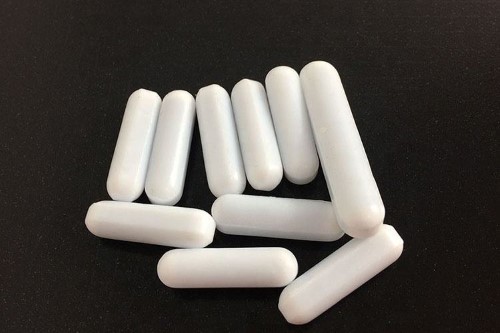
One of the most popular uses of Teflon-coated magnets is in the form of a magnetic stirrer bar, also known as a laboratory magnet, used in labs for stirring liquids in containers. A magnetic stirrer bar is coated with PTFE for protection against harsh chemical reactions, high temperatures, and other cleaning methods such as autoclaving. PTFE protects the magnetic stirrer bar from deterioration due to corrosive chemicals or high temperatures in a laboratory experiment.
In the production of magnetic stirrer bars, the process is usually completed through compression molding, whereby powdered PTFE is moulded on top of a magnet to produce a strong, smooth, and non-reactive surface. This accounts for the high-quality encapsulation that makes it possible for the magnetic stirrer to work well under various laboratory conditions.
2. Teflon Magnetic Tubes for Lithium-Ion Battery Testing
Another popular use of Teflon-encased magnets is for the analysis of metallic magnetic impurities in the cathode materials of Lithium-ion batteries. In the processing of Lithium-ion battery cathodes, metallic magnetic impurities are often incorporated. These result in side reactions between the cathode and the anode, which may impact the battery's functions. To offset this, Teflon-encased magnetic tubes aid in the identification and isolation of the metallic impurities.
The Teflon coating in this package is a very important component since it acts as a chemical-resistant coating against the harsh chemical composition of the acidic solution (aqua regia or nitric acid) used in dissolving the impurities. The magnetic tube assists in the separation of the magnetic impurities from the battery materials.
3. Operation in Harsh Industrial Environments
For instance, if the magnetic field is exposed to either corrosive substances or extreme temperatures, a Teflon-covered magnetic can assist. The use of a Teflon-coated magnetic may be especially useful while working with materials or using processes involving either corrosive materials or extreme temperatures. Even when exposed to temperatures that could melt regular magnets, a PTFE-covered magnetic can handle these situations.
Conclusion
Teflon or PTFE-coated magnets are very beneficial when it comes to protecting permanent magnets. This is because they offer an additional layer of protection compared to PTFE coatings. When considering laboratory devices, battery testing, or industries where protection against temperature, chemicals, or wear can become an issue, Teflon-coated magnets can handle these challenges effectively. For more tech support, please check Stanford Magnets.