

How Long Do Neodymium Magnets Last? Lifespan & Degradation Guide
Neodymium magnets are the strongest permanent magnetic material available today, and they're used everywhere from electric vehicles and consumer electronics to wind turbines and industrial robotics. But a lot of users have the same question: how long does that powerful magnetic force actually last?
How Long Does a Neodymium Magnet Hold Its Magnetic Strength?
"Permanent" Under Ideal Conditions
When stored and used under the right conditions—proper temperature, low humidity, and no strong external magnetic fields, radiation, or other interfering factors—neodymium magnets can hold their magnetic properties almost indefinitely. They don't "drain" like a battery. The source of their magnetism, the orderly alignment of magnetic domains, is thermodynamically stable without external interference.
Gradual Loss in Real-World Use
Of course, the real world is never perfectly ideal. Even without external interference, magnets slowly lose strength due to extremely gradual changes in their internal microstructure. Industry data shows that under normal operating conditions, neodymium magnets lose magnetic strength at a rate of roughly 1% per decade. In most applications, that rate is negligible.
To answer this question more precisely, a study conducted a 12-year experiment: eight uncoated neodymium samples were kept in room-temperature air (22°C–28°C), and their flux was measured at the same time each year.
The results showed almost no measurable magnetic loss in the first six years. A slow decline appeared after that point. The study concluded that coated neodymium magnets, under normal operating conditions, have an expected service life of 30 to 50 years with less than 1% magnetic loss.
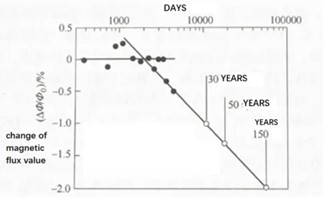
Rare-earth Permanent Magnet Materials by Hu Boping, Rao Xiaolei, Wang Yizhong 2017
One important caveat: the magnetic loss observed in the later stages of that experiment was primarily due to surface oxidation—because the samples were uncoated—rather than intrinsic decay of the magnetism itself. That means with proper protection, the lifespan can easily exceed that number.
What Accelerates Magnetic Decay?
Understanding what causes decay is the first step to extending magnet life. Here are the "big four" threats to neodymium magnets:
1. Excessive Heat – The Number One Threat
Neodymium magnets are temperature-sensitive. Standard grades have a maximum operating temperature of around 220°C. Above that, electron motion becomes increasingly random, magnetic domain alignment gets disrupted, and irreversible demagnetization occurs.
Even more critical: in alternating magnetic fields, like those inside a running motor, high temperature combined with field fluctuations creates hysteresis losses that accelerate permanent magnet failure. In some cases, hysteresis losses can actually outpace eddy current losses and become the primary cause of demagnetization.
What to do: Adding heavy rare-earth elements like dysprosium (Dy) or terbium (Tb) significantly boosts coercivity and heat resistance. Alternatively, choose high-temperature grades like SH, UH, or EH from the start.
2. Corrosion and Oxidation – The Slow-Burn Threat
Neodymium magnets have high iron content, making them highly susceptible to rust in humid or salt-spray environments. Corrosion starts at the surface and gradually eats inward, loosening the magnet's structure and steadily degrading performance.
One severe test: neodymium samples with a new SLIPS (slippery liquid-infused porous surface) coating showed no signs of corrosion after 136 days of immersion in 3.5% NaCl solution. Traditional nickel-copper-nickel (NiCuNi) plating, by contrast, tends to fail under those same conditions.
What to do: Use reliable surface protection—more on this below.
3. External Strong Magnetic Field Interference
Neodymium magnets can be demagnetized by external strong magnetic fields—especially alternating fields. Studies show that when an external alternating field hits 30 kA/m at 500 Hz, flux loss can exceed 15% almost instantly.
4. Vibration and Shock – The Synergy Factor
Vibration and shock don't usually cause demagnetization on their own. But at elevated temperatures, vibration can aggravate magnetic domain disorder, making the demagnetization problem worse.
How to Extend the Service Life of Neodymium Magnets
From all that has been stated, the key magnet life extension measures involve:
- Temperature Management
- Corrosion Prevention
- Field Isolation
1. Tightly Control Operating Temperature
Select appropriate grades based on operating temperatures. Standard N-series grade is sufficient for room temperatures (operating below 80°C). High temperatures require SH (150°C), UH (180°C), EH (200°C), and AH (220°C) grades.
Design cooling systems to reduce operating temperatures in dynamic environments. Oil and air cooling can be used in the motor. Embedding temperature sensors adjacent to the magnets is recommended.
If operating temperatures consistently exceed 200°C, you may need to consider samarium-cobalt magnets instead. But be aware of the trade-off: samarium-cobalt is more expensive, and its energy product is lower than neodymium's.
2. Choose a Reliable Surface Protection Coating
This is the most direct and effective way to prevent corrosion and extend service life. Here's a quick comparison of coating options:
|
Coating Type |
Best Suited For |
|
NiCuNi + Epoxy |
High humidity, high temperature, moist environments |
|
SLIPS (Slippery Liquid-Infused Porous Surface) |
Extreme corrosion, low-temperature icing conditions |
|
Al-Mo Composite Coating |
High temperature + high humidity, salt spray, high-wear environments |
3. Avoid External Strong Magnetic Fields and Extreme Mechanical Shock
- During storage and transport, keep magnets well away from strong field sources like transformers and large motors.
- Avoid heavy impacts. While the magnet material itself is hard and brittle, shock can indirectly accelerate crack propagation in existing micro-flaws.
Summary
|
Core Question |
Answer |
|
How long does the magnetic strength last? |
Under normal conditions: <1% loss over 30–50 years. Under ideal conditions: near-permanent. |
|
What's the biggest threat? |
Heat (>220°C) causes irreversible demagnetization; moisture causes corrosion. |
|
How do I extend lifespan? |
1. Choose the right temperature grade. 2. Apply proper surface coating. 3. Keep away from strong alternating magnetic fields. |
Need custom high-temperature or corrosion-resistant neodymium magnets for your project? Contact Stanford Magnets Team for material selection and engineering support.