

Round Neodymium Magnet Buying Guide: N35 to N52 Grades, Sizes, and Coatings
Round neodymium magnets are the classic, go-anywhere magnet shape. They're strong, compact, and lightweight—roughly 10 times stronger than standard ferrite magnets. A 1 cm diameter round neodymium magnet delivers about 3 kgf of holding force, while a 2 cm diameter magnet can reach 15 kgf. The round shape is simple to manufacture, offers uniform magnetic distribution, and installs easily, making it a fit for motors, speakers, headphones, industrial chucks, and countless other applications.
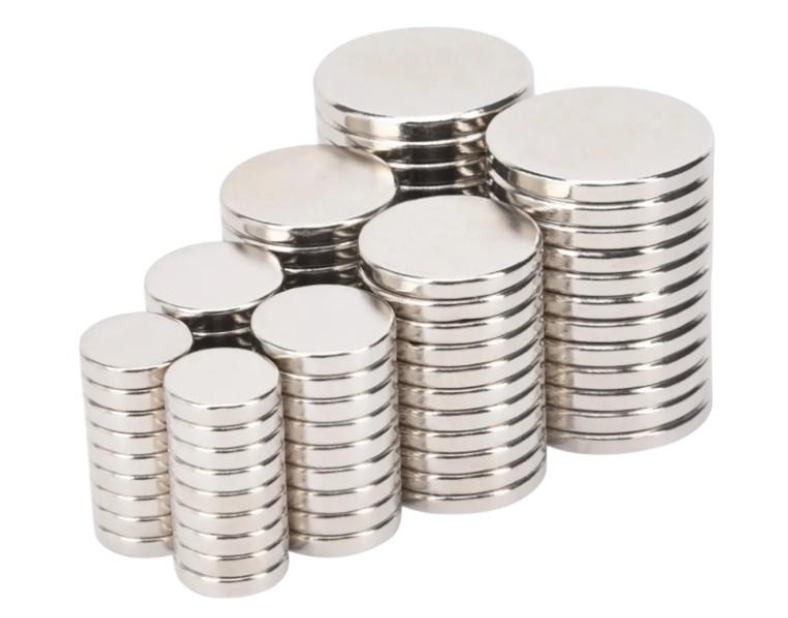
Stanford Magnets' round neodymium magnet line covers grades from N35 to N52 and N45SH, with thousands of in-stock sizes and full support for custom, non-standard orders based on drawings or samples. This guide breaks down how to choose round neodymium magnets across three key dimensions: grade, size, and coating.
How to Choose a Grade: Understanding the Performance Gap from N35 to N52
Round neodymium magnets range from N35 to N52. The higher the grade, the stronger the magnetic force. But the right choice depends on your actual requirements and operating temperature. If your working temperature exceeds 80°C, you'll need a high-temp grade like M (≤100°C), H (≤120°C), or SH (≤150°C).
Round Neodymium Magnet Grade Reference
|
Grade |
Max Energy Product (BH)max |
Surface Pull (Φ20×5mm) |
Max Operating Temp |
Typical Applications |
|
N35 |
33–36 MGOe |
~2.8 kg |
80°C |
Door catches, magnetic clasps, teaching aids, packaging |
|
N38 |
36–39 MGOe |
~3.2 kg |
80°C |
Sensors, general holding |
|
N40 |
38–41 MGOe |
~3.6 kg |
80°C |
Speakers, magnetic tools |
|
N42 |
40–43 MGOe |
~4.0 kg |
80°C |
Magnetic chucks, fixtures, precision holding |
|
N45 |
43–46 MGOe |
~4.5 kg |
80°C |
Drone motors, medical devices |
|
N48 |
46–49 MGOe |
~5.0 kg |
80°C |
High-performance motors, industrial automation |
|
N50 |
48–51 MGOe |
~5.5 kg |
80°C |
Advanced electronics, high-end audio |
|
N52 |
50–53 MGOe |
~6.0 kg |
80°C |
Maximum holding, strongest commercially available |
|
42M |
40–43 MGOe |
~3.8 kg |
100°C |
Industrial equipment with mild temperature rise |
|
48M |
46–49 MGOe |
~4.8 kg |
100°C |
Strong holding at moderate temperatures |
|
50M |
48–51 MGOe |
~5.2 kg |
100°C |
Heat-generating equipment requiring high magnetic force |
|
35H |
33–36 MGOe |
~2.5 kg |
120°C |
Power tools, fan motors |
|
45H |
43–46 MGOe |
~4.1 kg |
120°C |
Automotive motors, high-performance industrial equipment |
|
48H |
46–49 MGOe |
~4.6 kg |
120°C |
High-temperature, high-force applications |
|
42SH |
40–43 MGOe |
~3.3 kg |
150°C |
High-performance, high-temperature motors |
|
45SH |
43–46 MGOe |
~3.8 kg |
150°C |
High-performance, high-temperature motors |
The pull values above are reference figures for a Φ20×5mm round magnet on a thick steel plate, measured perpendicular to the surface. Actual pull depends on plate thickness, contact area, magnetization direction, and other factors. So temperature isn't the only thing to consider—size matters too. If you need 10% more holding force, increasing thickness by 1 mm may cost only half as much as stepping up a grade.
How to Choose the Size of a Round Neodymium Magnet
A round neodymium magnet's holding force depends not just on grade but on its size ratio. Two magnets of the same weight can differ in pull by 2–3× depending on their diameter-to-thickness ratio.
Round neodymium magnets are typically specified as diameter × thickness. Common sizes include 5×2, 10×3, 15×5, and 20×5. The size range spans from tiny 1 mm diameter magnets to large 200 mm diameter units.
Diameter-to-Thickness Relationship
|
D/T Ratio |
Magnetic Characteristics |
Typical Applications |
|
D/T ≈ 1 (e.g., Φ10×10) |
Maximum pull, concentrated radial field |
Where maximum perpendicular pull is needed |
|
D/T ≈ 2–4 (e.g., Φ20×5) |
Best balance of pull and cost |
Most versatile, covers ~80% of applications |
|
D/T ≈ 5–10 (e.g., Φ30×3) |
Moderate pull, large contact area |
Surface-mount and large-area contact |
|
D/T > 10 (e.g., Φ50×2) |
Thin disc, lower pull |
Mounting, positioning, space-constrained use |
Common Round Neodymium Magnet Sizes and Typical Applications
|
Size |
Reference Grade |
Perpendicular Pull |
Typical Applications |
|
Φ5×2mm |
N35 |
~0.3 kg |
Phone motors, micro sensors |
|
Φ10×3mm |
N38 |
~1.0 kg |
Packaging clasps, electronic positioning |
|
Φ15×5mm |
N38 |
~2.0 kg |
Door catches, tool holding |
|
Φ20×5mm |
N42 |
~4.0 kg |
Magnetic fixtures, industrial holding |
|
Φ25×5mm |
N42 |
~5.5 kg |
Magnetic chucks, automation equipment |
|
Φ30×10mm |
N42 |
~10 kg |
Heavy-duty magnetic lifters |
|
Φ50×10mm |
N45 |
~25 kg |
Industrial sorting, large chucks |
|
D100×20mm |
N42 |
~80 kg |
Heavy industry, magnetic lifting |
How to Choose the Coating for a Round Neodymium Magnet
Neodymium magnets rust easily, so a protective coating is typically required. Common options include nickel, zinc, and epoxy—each extending service life and suiting different environments.
Comparison of 5 Mainstream Coatings
|
Coating Type |
Salt Spray Resistance |
Appearance |
Cost |
Suitable Environment |
|
Zinc (Zn) |
12–24h |
Silver-white / colored |
Lowest |
Indoor, dry |
|
Nickel-Copper-Nickel (NiCuNi) |
24–72h |
Bright silver |
Low |
Standard indoor (most common) |
|
Epoxy |
72–120h |
Black |
Medium |
Humid environments |
|
NiCuNi + Epoxy |
120–240h |
Black |
Higher |
Long-term outdoor |
|
Gold / Silver |
48–96h |
Gold / silver |
High |
Decorative, precision electronics |
Recommendations by Environment
- Indoor, dry: NiCuNi—most mainstream, best cost-performance
- Indoor with moisture: Epoxy—stronger corrosion protection
- Long-term outdoor exposure: NiCuNi + Epoxy dual layer—200+ hours salt spray
- Marine, high-salt environments: NiCuNi + Epoxy or Dacromet coating
- High-temperature (>150°C): Nickel plating (epoxy breaks down at high temps)
Magnetization Direction for Round Neodymium Magnets
Many customers overlook magnetization direction, but it directly affects how the magnet performs.
|
Magnetization |
Description |
Characteristics |
Typical Applications |
|
Axial |
N-S along thickness |
Most common; top and bottom faces are N and S poles |
~90% of round magnet applications |
|
Radial |
N-S along diameter |
Less common; for special magnetic circuits |
Sensors, specialty motors |
|
Multi-pole |
Multiple N-S alternating on surface |
Multiple poles on one face; strong holding on contact surface |
Magnetic couplings, magnetic gears |
Round neodymium magnets default to axial magnetization. If you need radial or multi-pole magnetization, specify it when ordering. Stanford Magnets supports full customization of magnetization patterns.
Reading more
What Effect Does Coating Have on a Magnet's Magnetic Force?
How Long Do Neodymium Magnets Last? Lifespan & Degradation Guide
How to Get Maximum Pulling Force from Your Magnets
Buyer's Guide: Frequently Asked Questions About Neodymium Magnets