

How Neodymium Magnets Are Used in the Automotive Industry
Neodymium magnets—technically called neodymium-iron-boron (NdFeB) permanent magnets—are the strongest permanent magnets out there. Since they hit the scene in the 1980s, these magnets have found their way into all kinds of industries. And the automotive industry is one of the biggest users. Whether we're talking about gas-powered cars or electric vehicles, neodymium magnets play a key role.
1. Neodymium Magnets Is The Core Material for EV Drive Motors
In both pure EVs and hybrids, the drive motor is what turns electricity into mechanical energy to spin the wheels. The most common type of drive motor today is the permanent magnet synchronous motor (PMSM). The rotor in this kind of motor uses permanent magnets to create a steady magnetic field.
Because neodymium magnets have high remanence (residual magnetism) and high coercivity (resistance to demagnetization), they can pack a strong magnetic field into a small space. That means the motor can run at a higher power density.
To give you an idea: a pure EV uses about 5 kilograms of neodymium magnets in its drive motor. A hybrid uses about 2.5 kilograms. By comparison, a conventional gas-powered car typically uses less than 1 kilogram total. So the shift to electric vehicles is a huge driver of neodymium magnet demand.
Drive motors generate a lot of heat during operation—internal temperatures can easily exceed 100°C. Regular permanent magnets can lose their magnetism at those temperatures, which hurts motor performance. To get around this, magnet manufacturers usually add heavy rare earth elements like dysprosium or terbium to improve high-temperature stability. In recent years, thanks to process improvements like grain boundary diffusion, some high-performance neodymium magnets can now keep good heat resistance with little or no heavy rare earths.
2. Neodymium Magnets for Small Motors in Auxiliary Systems
Beyond the drive motor, modern cars are packed with dozens of small motors for all sorts of auxiliary functions. These motors also use a lot of neodymium magnets.
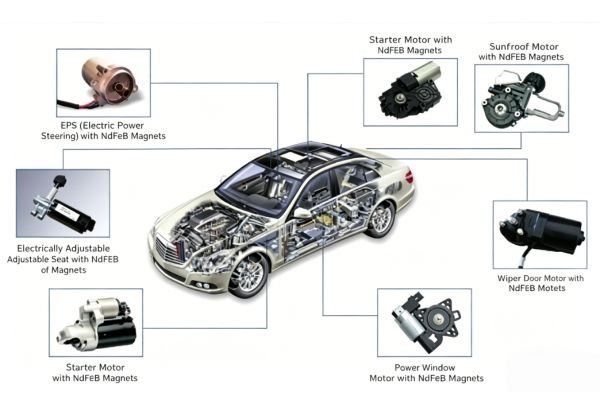
Electric power steering (EPS) is a great example. EPS uses an electric motor to provide assist torque, making it easier for the driver to turn the wheel. Compared to old-school hydraulic power steering, EPS is simpler, uses less energy, and doesn't rely on engine power. The motor in an EPS system typically uses neodymium magnets to get high torque density and fast response.
Neodymium magnets are also found in:
- ABS (anti-lock braking system) modulator motors
- Electronic parking brake actuators
- Power window motors
- Power seat adjustment motors
- Blower and compressor motors in HVAC systems
- Cooling fan motors
- Water pump and oil pump motors
- Wiper motor
- Starter motor
- Compressor motor
Each of these small motors uses only a small amount of neodymium, but with so many motors in each car, it really adds up.
Conclusion
Because of their superior magnetic performance, neodymium magnets have become irreplaceable in the automotive industry. They provide the foundation for both power delivery and everyday functions in modern vehicles.
Read more:
How Magnets Are Used in Medicine
Why Neodymium Magnets Are the Go-To Choice for Audio Gear
What Is Electromagnetic Therapy?