

Circular Halbach Array/Halbach Array Ring: An Innovative Magnet Design
The Halbach Array is a unique arrangement of permanent magnets that creates a highly efficient and optimized magnetic field. When designed in a circular configuration, known as the Circular Halbach Array (CHA) or Halbach Array Ring, it holds immense potential for a variety of high-performance applications, from magnetic resonance imaging (MRI) to transportation systems. Let's learn about their principles, key advantages, practical uses, and future directions.
[1]
What Is A Circular Halbach Array?
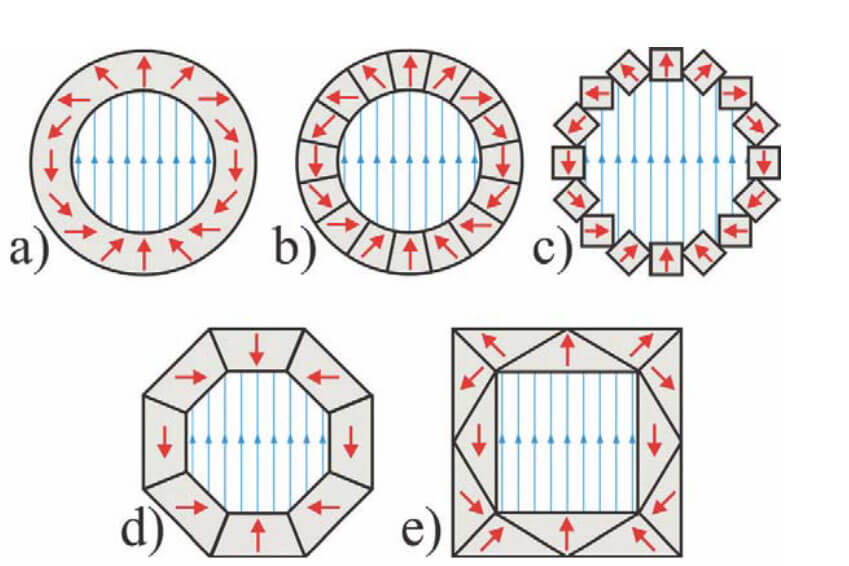
A Halbach Array is an arrangement of permanent magnets where the magnetic field is enhanced on one side while being canceled or minimized on the other side. This phenomenon occurs due to the strategic alignment of the magnetization vectors of the individual magnets. In a Circular Halbach Array, these magnets are arranged in a ring-like shape, optimizing the magnetic field in a specific direction. The resulting magnetic field is especially intense on the interior of the ring, while the exterior field is weak or nearly nonexistent.
The basic concept was first developed by physicist Klaus Halbach in the 1980s to improve the performance of accelerators and other systems. In a traditional Halbach Array, the arrangement of the magnets leads to the cancellation of opposing magnetic fields, thus concentrating the magnetic flux on one side. The Circular Halbach Array takes this concept further by utilizing a continuous, symmetrical design, which makes it particularly useful for applications requiring a uniform magnetic field within a circular region.
How Does A Halbach Array Ring Work?
The design of the Halbach Array Ring leverages the interaction of multiple permanent magnets arranged in a specific sequence, typically in a cylindrical or toroidal shape. In the circular configuration, the magnetic poles of each magnet are oriented at different angles relative to the others. This allows for a highly focused magnetic field inside the array while leaving the outside relatively weak.
In simple terms, the direction of magnetization of each magnet is rotated as you move around the circumference of the array. This rotational symmetry ensures that the magnetic field inside the array is aligned in the direction of interest, while the external field is minimized, which is especially useful for systems that require minimal interference with surrounding components.
Key Advantages of the Circular Halbach Array
- Enhanced Magnetic Field Efficiency:
One of the most significant benefits of a Circular Halbach Array is the optimized magnetic field it generates. Unlike conventional magnet configurations, the Halbach Array Ring can produce a highly concentrated magnetic field within a defined space. This can be crucial in applications such as magnetic levitation, where strong, localized fields are required to float or move objects. - Compactness:
Due to the efficient magnetic field distribution, Circular Halbach Arrays can be much more compact than other traditional magnetic systems. The reduction in the size and weight of the magnetic components makes it ideal for applications where space is limited, such as in small-scale motors or portable magnetic devices. - Reduced External Magnetic Interference:
By minimizing the magnetic field outside of the array, Circular Halbach Arrays are less likely to interfere with nearby electronic components or systems. This property is particularly beneficial in MRI machines or scientific instruments where external magnetic interference can lead to errors or reduced performance. - Improved Power Efficiency:
The efficiency of a Halbach Array Ring is directly tied to the performance of the systems that use it. By focusing the magnetic field, less energy is required to achieve the same or better results compared to traditional magnet configurations, making these arrays ideal for applications where power consumption is critical.
Applications of Halbach Array Rings
The potential of the Circular Halbach Array is vast, with numerous applications in both industrial and scientific fields. Some of the key areas where CHAs are used include:
1. Magnetic Levitation and Transportation
In magnetic levitation (maglev) systems, the CHA is used to generate a stable and strong magnetic field that can levitate and propel vehicles without friction. The highly concentrated magnetic field in the center of the array provides the necessary lift, while the lack of external magnetic flux prevents unwanted interference with surrounding structures. For example, maglev trains in Japan and China use variations of this technology to achieve high-speed transportation with minimal friction, offering a promising alternative to traditional rail systems.
2. Magnetic Resonance Imaging (MRI)
MRI machines rely on strong magnetic fields to generate detailed images of the body's internal structures. Traditional MRI systems often require large, bulky magnets to create the required magnetic fields. The Circular Halbach Array provides a more compact and efficient solution for these machines. By utilizing a CHA, the system can maintain high-quality imaging while reducing the size and cost of the device. This makes it particularly valuable in portable or mobile MRI systems.
3. Energy Harvesting Systems
The Halbach Array Rings can also be utilized in energy harvesting systems, particularly in vibration-based energy harvesters. The efficient magnetic field generated by the CHA can be used to induce current in coils placed near the array, converting mechanical motion into electrical energy. This approach is particularly useful for small-scale devices or sensors that require low-power operation over long periods.
4. Electric Motors and Generators
In electric motors, particularly in small-scale or high-efficiency applications, the Halbach Array Ring offers superior magnetic field concentration that increases torque while reducing the size of the motor. This makes it an excellent choice for applications like drones, electric vehicles, and robotics, where compactness and efficiency are key considerations.
5. Particle Accelerators
In particle accelerators, Halbach Arrays are used to manipulate charged particles with precision. The use of a Halbach Array Ring allows for a compact and highly focused magnetic field that is critical for controlling and accelerating particles in these systems. They are used in various experiments, particularly in high-energy physics and nuclear fusion research, where precise control of magnetic fields is necessary.
Related reading: All about Halbach Arrays
Conclusion
The Circular Halbach Array represents a significant breakthrough in magnetic field design, providing an efficient, compact, and powerful solution for a variety of high-performance applications. From magnetic levitation to energy harvesting and MRI systems, the Halbach Ring is a transformative technology that is already proving its worth across multiple industries. As materials and manufacturing processes continue to evolve, the potential applications of the CHA will undoubtedly expand, offering even greater possibilities for innovation in the future.
Reference:
[1] Soltner, H. and Blümler, P. (2010), Dipolar Halbach magnet stacks made from identically shaped permanent magnets for magnetic resonance. Concepts Magn. Reson., 36A: 211-222.