

The Complete Guide to High-Temperature Neodymium Magnets
Neodymium (NdFeB) permanent magnets far outperform traditional ferrite and samarium cobalt magnets in overall performance. However, they have one inherent weakness: a relatively low Curie temperature (310–340°C). Standard neodymium magnets start losing strength irreversibly above 80°C, which used to seriously limit their use in high-end applications. High-temperature neodymium magnets were developed specifically to solve this problem.
1. Why Are High-Temperature Neodymium Magnets More Heat-Resistant?
To explain the advantages of high-temperature neodymium magnets, one should first understand why ordinary magnets cannot stand high temperatures.
1.1 Why Do Regular Neodymium Magnets Struggle with Heat?
Coercivity (resistance to demagnetization) of NdFeB magnets possesses a negative temperature coefficient and amounts to -0.4%-0.7%/°C. Thus, for each degree Celsius of temperature increase, magnets lose about 0.4%-0.7% of their resistance. As an example, consider the popular N52 magnet. Its coercivity at 20°C equals 12 kOe. However, when heated to 100°C, it loses about half of its resistance, i.e., its coercivity becomes equal to 8-9 kOe.
The decrease in coercivity occurs due to two microscopic processes:
- The magnetocrystalline anisotropy field decreases with rising temperature because increasing temperature results in stronger atomic vibrations, which prevent the lattice from fixing the magnetic moments in place.
- Neodymium-containing grain boundary phase is softened or oxidized at high temperatures and, thus, cannot hinder domain walls' movement.
1.2 The Technology Behind High-Temperature Neodymium Magnets
High-temperature neodymium magnets solve these problems using grain boundary diffusion (GBD) technology.
This process introduces heavy rare earth elements like dysprosium (Dy) or terbium (Tb) onto the magnet's surface. Then, through heat treatment, these heavy rare earth atoms diffuse along the grain boundaries and selectively replace neodymium atoms in the outer layer of the main phase grains. This forms a (Nd,Dy)₂Fe₁₄B shell structure with a high anisotropy field.

Neodymium High Temp Cylinder Magnet N52SH 1/8" dia. x 1/8" thick
1.3 The Core Mechanism
The heavy rare earths precipitate themselves along the grain boundaries, while undergoing a phase transformation at elevated temperatures, resulting in a "core-shell" structure surrounding the anisotropic main phase grains. It may be likened to placing a protective layer of heat-resistant armor around each grain. Such an armor protects the magnetic domains from any change at elevated temperatures.
In comparison with other alloying techniques, the use of grain boundary diffusion in obtaining high coercivity requires significantly smaller amounts of heavy rare earths, thus alleviating the problem of their shortage. Experiments have shown that magnets produced using the above method can reduce coercivity loss at 150°C by more than 50%.
2. Grades and What They Mean
High-temperature neodymium magnets are identified by a letter-based grade system. Understanding this system is key to selecting the right magnet for your application.
2.1 Grade Naming Rules
A neodymium magnet grade usually has three parts. Take "N42SH" as an example:
|
Part |
Example |
Meaning |
|
Prefix letter |
N |
Neodymium magnet |
|
Number |
42 |
Maximum energy product (MGOe); higher number = stronger magnetic performance |
|
Suffix letter |
SH |
Temperature rating; letters later in the alphabet indicate higher heat resistance |
2.2 Temperature Rating Reference Table
Different suffix letters correspond to different maximum operating temperatures. Choosing the right grade is essential for long-term stability under your actual operating conditions.
|
Suffix |
Max Operating Temp |
Example Grades |
Applications |
|
No suffix (N) |
80°C |
N35–N52 |
Room temperature, consumer electronics |
|
M |
100°C |
35M–52M |
General industrial motors |
|
H |
120°C |
33H–50H |
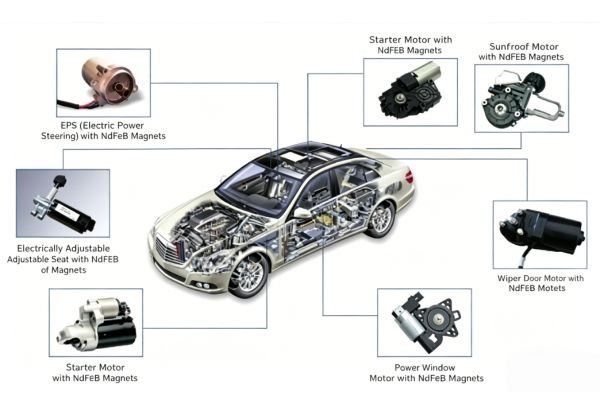
Servo motors, automotive |
|
SH |
150°C |
30SH–48SH |
EV drive motors |
|
UH |
180°C |
28UH–45UH |
Wind power, aerospace |
|
EH |
200°C |
28EH–42EH |
High-temperature industrial environments |
|
AH |
220–230°C |
28AH–40AH |
Extreme high-temperature conditions |
Note: The temperatures above are typical values. Actual performance may vary slightly between manufacturers. Always leave some safety margin when selecting.
3. Applications Made Possible by High-Temperature Neodymium Magnets
The breakthrough of high-temperature neodymium magnets has directly enabled several high-tech industries.
3.1 EV Drive Motors
The drive motor of electric vehicles must be at very high levels of power density. The motor produces a lot of heat and operates in conditions of constant vibrations and elevated temperatures. Ordinary magnets would demagnetize very quickly in such conditions. High-temperature neodymium magnets (primarily SH and UH types) allow for permanent magnet synchronous motors to attain an efficiency rate of over 97% while ensuring that their lifespan exceeds 10 years.
3.2 Wind Power Generation
NdFeB magnets are an essential element of permanent magnet direct-drive wind turbines. One 2.5 MW permanent magnet direct-drive wind turbine consumes about one ton of NdFeB magnets. Offshore wind power, in particular, demands magnets that can run long-term in harsh environments with moisture, salt spray, and wide temperature swings. UH and EH grade high-temperature neodymium magnets are the only choice.
3.3 Industrial Robots and Servo Motors
The joint motors in industrial robots are small, carry heavy loads, and heat up quickly. High-temperature neodymium magnets ensure positioning accuracy and dynamic response under high-intensity, high-frequency operation. They're a core enabling material for smart manufacturing.
3.4 Medical Equipment (MRI)
MRI machines need to generate extremely stable and powerful magnetic fields. NdFeB magnets, with their ultra-high energy product, have become the mainstream choice for MRI systems. The demanding requirements for magnetic field stability make high-temperature grades absolutely necessary.
4. Important Usage Precautions
Even if you've chosen the correct high-temperature grade, improper use can still cause demagnetization or failure.
4.1 Avoid Operating Above the Temperature Rating
This is the most important thing to remember. The maximum operating temperature for each grade is a tested limit. Long-term exposure above that limit—even just 10–20°C over—will slowly damage the magnetic domain structure and gradually reduce magnetic strength.
Even more dangerous is short-term thermal shock. Just a few seconds at too high a temperature can instantly randomize the magnetic domains, causing permanent, complete demagnetization.
4.2 Protect Against Corrosion
The composition of NdFeB magnets is mostly iron (65% in Nd₂Fe₁₄B), which is highly susceptible to corrosion and oxidation. Exposure to moist conditions, salt spray, or an acidic/alkaline environment leads to corrosion and subsequent destruction of the magnetic material, thus resulting in demagnetization.
4.3 Avoid Impact Damage
NdFeB magnets are known to be brittle. Any strong impact on them can cause cracks or breaks and disturb the ordered arrangement of the magnetic domains, thus resulting in demagnetization.
4.4 Avoid Strong Reverse Magnetic Fields
If an NdFeB magnet is brought near a strong reverse magnetic field (an electromagnet or the other pole of a permanent magnet) that exceeds the coercivity of the magnet, then the magnetic domains will be forced to reorder themselves, thus leading to demagnetization.
Conclusion
High-temperature neodymium magnets have successfully overcome the heat sensitivity of standard NdFeB through advanced technologies like grain boundary diffusion. This allows them to perform exceptionally well in high-temperature applications such as electric vehicles and wind power generation.