

Countersunk vs. Counterbored Neodymium Magnets: How to Choose the Right Hole
Choosing a neodymium magnet with a mounting hole seems straightforward. But there is one detail that can cause unexpected problems: the hole type.
Some buyers need a magnet that fits a flat-head screw. Others plan to use a socket head cap screw with a hexagonal drive. These fasteners look and fit differently, so they require different hole designs.
Ordering the wrong type can leave the screw head sticking out, prevent the magnet from sitting flat, or even crack the magnet during installation. Before placing an order, make sure you know the difference between a countersunk hole and a counterbored hole.
1. What Is a Countersunk Neodymium Magnet?
A countersunk neodymium magnet has a conical recess around its mounting hole. The angled surface matches the underside of a countersunk flat-head screw.
When the screw and hole dimensions match, the screw head sits flush with or slightly below the magnet's surface. This creates a low-profile installation without a protruding screw head.
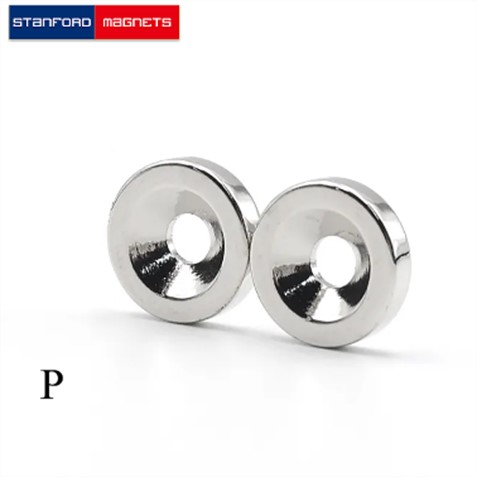
Neodymium Countersunk Magnet (Pull Force(Lbs): 5.35) from Stanford Magnets
Countersunk magnets are commonly used for mounting fixtures, magnetic catches, panels, signs, and other components where a relatively flat surface is important.
Key features:
- Hole shape: Conical or tapered
- Compatible fastener: Countersunk flat-head screw
- Main benefit: Allows the screw head to sit flush with the magnet's surface
- Typical applications: Fixtures, panels, magnetic catches, and mounting assemblies
2. What Is a Counterbored Neodymium Magnet?
A counterbored neodymium magnet has a cylindrical recess with a flat bottom around its mounting hole. This larger, shallow recess accommodates the head of a screw or bolt.
Counterbored holes are commonly used with socket head cap screws, including screws with a hexagonal socket. When the recess has the correct diameter and depth, the screw head can sit flush with or below the magnet's surface.
The exact fit depends on the screw head dimensions and the depth of the counterbore. A counterbored hole is not interchangeable with a countersunk hole simply because both can recess a screw head.
Key features:
- Hole shape: Cylindrical, with a flat bottom
- Compatible fastener: Typically a socket head cap screw
- Main benefit: Accommodates a larger cylindrical screw head
- Typical applications: Mechanical fixtures, equipment assemblies, and recessed mounting systems
3. Countersunk vs. Counterbored: What Is the Difference?
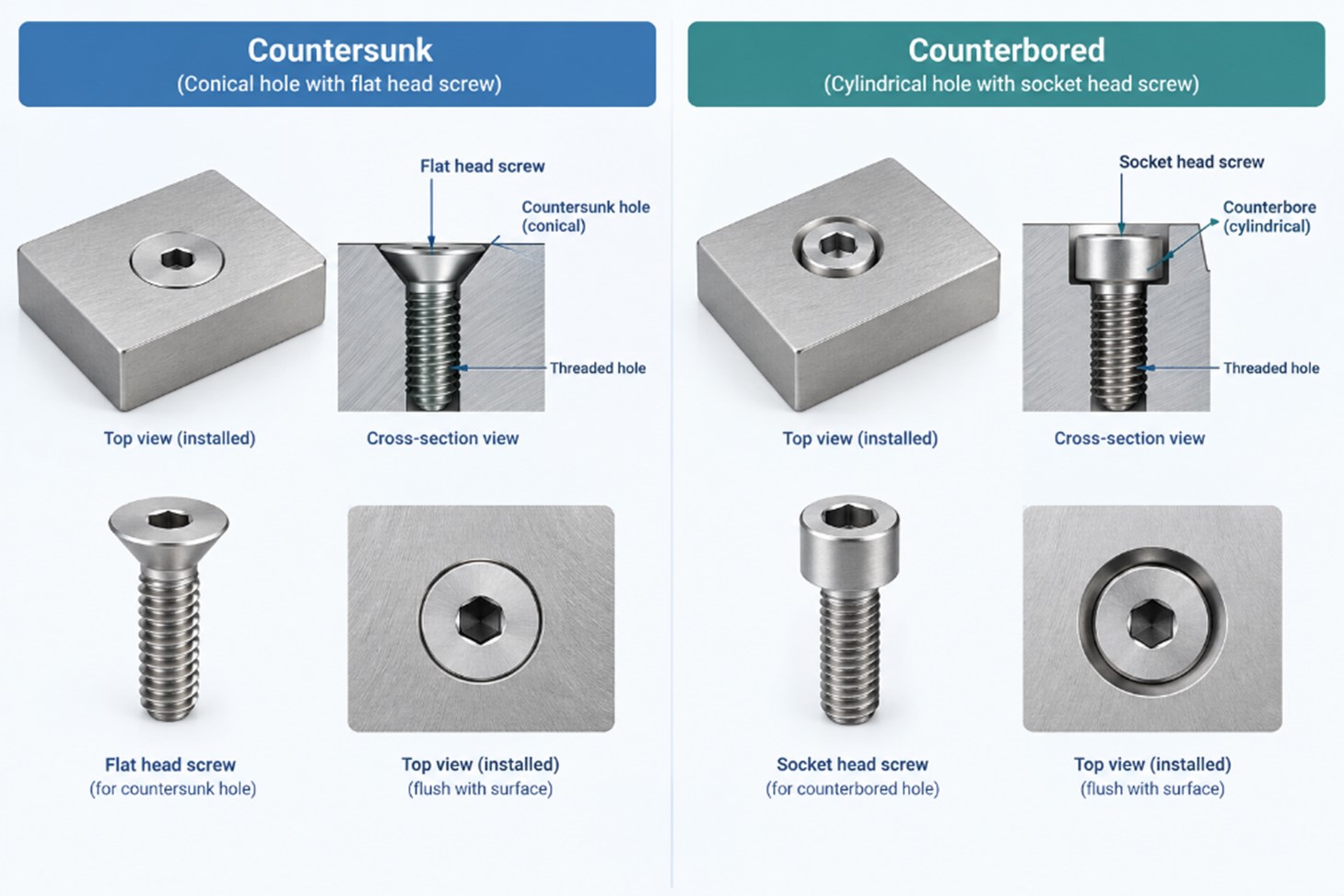
The main difference is the geometry of the recess and the shape of the screw head it accommodates.
|
Feature |
Countersunk Magnet |
Counterbored Magnet |
|
Hole geometry |
Conical or tapered |
Cylindrical with a flat bottom |
|
Typical screw type |
Flat-head countersunk screw |
Socket head cap screw |
|
Screw head shape |
Tapered underside |
Cylindrical head with a flat underside |
|
Seating surface |
Angled surface |
Flat-bottomed recess |
|
Main purpose |
Recessing a flat-head screw |
Recessing a cylindrical screw head |
|
Key dimensions |
Hole diameter, countersink diameter, angle, and depth |
Hole diameter, counterbore diameter, and depth |
The easiest way to remember the difference: a countersunk hole has an angled seat, while a counterbored hole has a cylindrical recess with a flat bottom.
4. What Happens If You Choose the Wrong Hole Type?
Using the wrong hole design can cause more than an untidy installation. It can affect the fit, reliability, and service life of the assembly.
The Screw Head May Not Sit Flush
A flat-head screw needs an angled seat. If you use it with a counterbored hole, the head may not seat properly.
Likewise, a socket head cap screw cannot seat correctly in a conventional countersunk hole. The two geometries are designed for different screw heads.
The Magnet May Crack During Installation
Neodymium magnets are hard but brittle. Unlike steel, they do not tolerate significant deformation.
If a screw head contacts the wrong surface, or if the screw is tightened too much, it can create concentrated stress around the hole. The magnet may chip or crack, especially when the remaining material around the hole is thin.
To reduce this risk, match the screw to the hole geometry, check the dimensions, and avoid excessive tightening. Do not force a screw into a hole that does not fit.
The Assembly May Not Work as Intended
A protruding screw head can interfere with nearby components or prevent the magnet from sitting flat against its mounting surface. In a close-fitting assembly, even a small mismatch can lead to rework or replacement.
Checking the hole type before ordering is much easier than correcting the problem after the magnets arrive.
5. How to Choose the Right Hole Before Ordering
Before selecting a neodymium magnet, check the following details.
Step 1: Identify the screw head type.
Check whether your application uses a countersunk flat-head screw or a socket head cap screw. If you are unsure, send your supplier a photo or the screw's part number.
Step 2: Confirm the screw dimensions.
Do not rely on the screw's nominal size alone. The head diameter, head height, and underside geometry all affect the fit.
Step 3: Check the hole dimensions.
For a countersunk hole, confirm the screw size, countersink diameter, angle, and depth.
For a counterbored hole, confirm the mounting hole diameter, counterbore diameter, and counterbore depth.
Step 4: Check the magnet's thickness and remaining material.
The recess must accommodate the screw head without leaving too little material around the hole. This is particularly important for thin magnets, where the available space is limited.
Step 5: Consider the installation method.
Neodymium magnets are brittle, so avoid using excessive screw torque. The correct installation method depends on the magnet dimensions, mounting surface, fastener, and application requirements.
6. Need Help Selecting a Countersunk Neodymium Magnet?
The right hole design depends on the fastener and the available mounting space. If you are sourcing magnets for a new assembly, confirm these details before placing an order.
Stanford Magnets offers neodymium magnets with countersunk mounting holes in different shapes and sizes. If a standard option does not meet your requirements, contact our team to discuss your application.
Not sure which hole type you need? Send us your screw specifications, a product drawing, or a photo of the fastener. We'll help you identify the appropriate hole design before you order.