

Magnets in Outdoor Applications: A Complete Overview
When people think of outdoor gear, the first things that come to mind are usually tents, backpacks, and jackets. But there's one category of material that shows up almost everywhere and rarely gets discussed on its own: magnets.
From small lights clipped to tent poles at a campsite, to magnetic retrieval tools used to fish dropped keys out of the water, to magnetic sunshades mounted on the outside of RVs—magnets have quietly worked their way into nearly every corner of outdoor life. This article takes a systematic look at how magnets are used in outdoor settings.
Magnets for Fastening and Connecting
Outdoors, securing things is always a necessity. Drilling, tying ropes, and snap clips each have their limits, but magnetic solutions win on speed, removability, and leaving surfaces undamaged.
Magnetic Hooks and Hanging
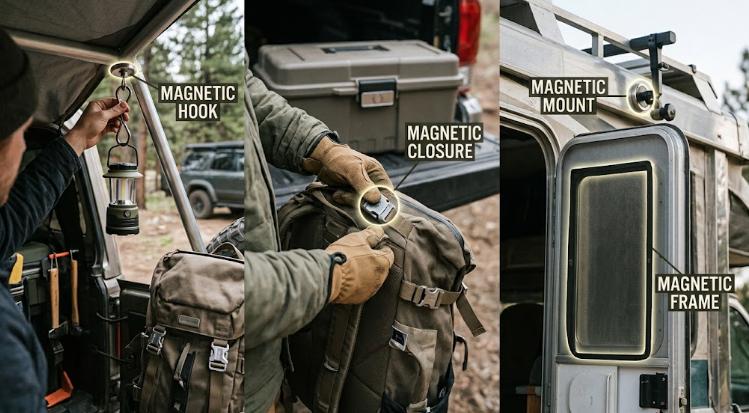
On a camping trip, a neodymium magnetic hook can easily attach to a tent pole, car roof, or metal tabletop to hold camp lights, cookware, or trash bags. In garages and warehouses, magnetic hooks are also great for organizing tools and cables. Ferrite magnets are more commonly used for outdoor signage and display boards, thanks to their low cost and good weather resistance.
Bag and Door Closures
Magnetic closures on outdoor storage boxes, toolboxes, and coolers; magnetic fasteners on tent doors and rain flies; magnetic buckles on backpacks and camera bags. These are all classic magnet applications. The appeal of magnetic closures is one-handed operation—you can open and close them easily even with gloves on.
Vehicle Mounting
Magnetic positioning aids for roof racks and bike racks; magnetic phone mounts and walkie-talkie holders; magnetic sunshades and mosquito screens for RVs. These applications demand stronger magnetic force and typically require powerful neodymium magnets.
Magnets for Detection and Retrieval
Magnetic Retrieval Tools
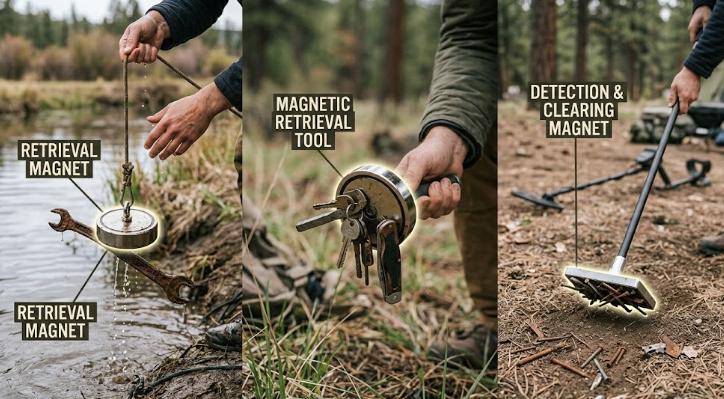
This is one of the most familiar magnet applications for anglers and outdoor workers. When keys, knives, or tools end up in water or tall grass, a powerful neodymium retrieval magnet solves the problem. Pull force ranges from tens of kilograms to several hundred, and with the right model, you can even pull up a wrench.
Metal Detection Support
Used alongside metal detectors, magnets help pinpoint ferromagnetic targets and clear dangerous debris like nails and screws from an area—especially important at campsites or places where children play.
Magnets in Outdoor Gear and Tools
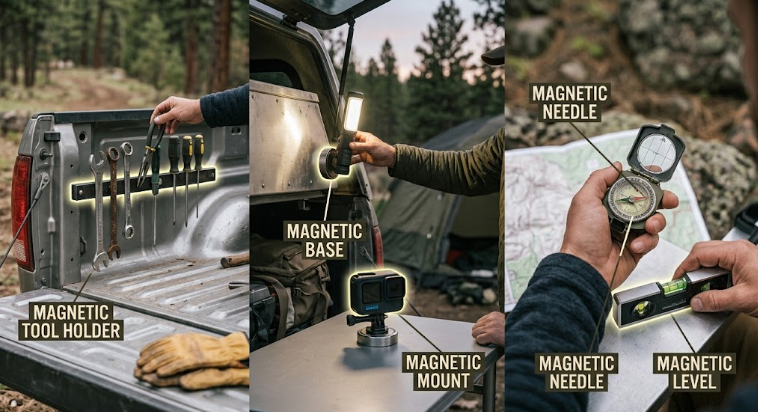
Magnetic Tool Holders
Magnetic tool bars on pickup trucks and service vehicles, and magnets used to hold metal parts in place during welding—these are magnet staples. Ferrite magnets are common in low-cost tool storage solutions because of their affordability.
Lighting and Electronics
Magnetic headlamps, work lights, magnetic power banks, Bluetooth speakers, and magnetic mounts for action cameras—these products are increasingly common outdoors. The advantage is quick attach-and-detach without messing with screws.
Navigation and Measurement
The needles in compasses are specialized magnets, and magnetic angle finders and levels also rely on magnets. These applications demand high precision and stability.
Magnets for Recreation and Sports
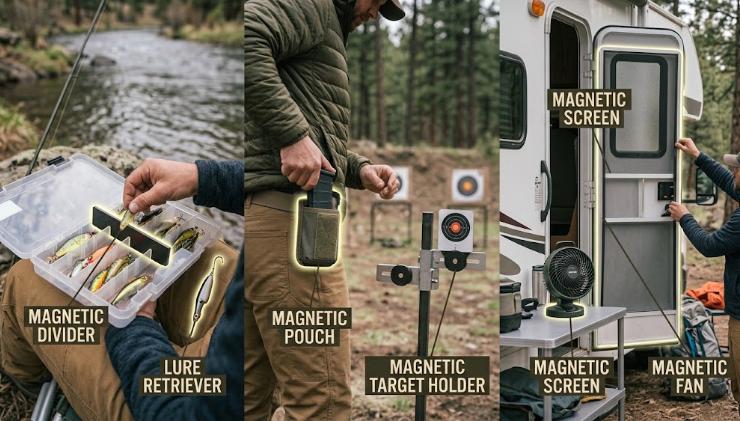
Fishing
Beyond retrieval magnets, magnetic dividers in tackle boxes and magnetic lure retrievers are also common.
Archery and Shooting
Magnetic target accessories and magnetic magazine pouches for quick reloads—these applications require fast response and durability from the magnets.
Camping and RVs
Magnetic screens, sunshades, lights, fans, and magnetic storage on RV refrigerators. These scenarios usually don't need high magnetic force, but they are sensitive to weather resistance and cost.
Magnets in Industrial and Engineering Outdoor Settings
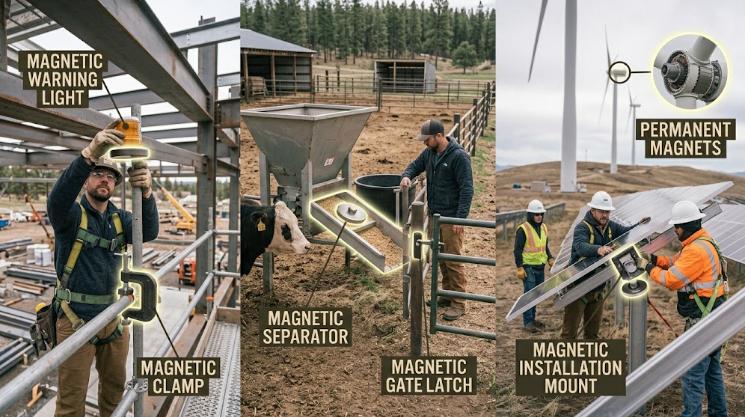
Construction and Maintenance
Magnetic scaffolding accessories, magnetic safety warning lights, and magnetic clamps for pipes and steel structures—these applications demand high pull force and durability.
Agriculture and Farming
Magnetic separators in feed remove iron contaminants, and magnetic livestock ear tags and fencing accessories are also common.
Wind Power and Energy
Permanent magnets in wind turbines are a major industrial application for neodymium magnets, and magnetic-assisted installation for solar panel mounts is gaining traction.
Neodymium vs. Ferrite Magnets: Which to Choose Outdoors?
|
Factor |
||
|
Magnetic strength |
Extremely strong |
Moderate |
|
Temperature resistance |
Poor (generally ≤80°C; high-temp grades up to 200°C) |
Good (up to 250°C) |
|
Corrosion resistance |
Poor; must be coated (nickel, epoxy) |
Good; naturally oxidation-resistant |
|
Cost |
High |
Low |
|
Outdoor suitability |
Needs protection; suited for high-strength fastening |
Suited for long-term exposure and low-cost scenarios |
Key reminders:
- Neodymium magnets must be properly protected against corrosion outdoors. Once the coating is damaged, the magnet itself oxidizes and crumbles rapidly, and magnetic strength drops sharply.
- In high-temperature environments, choose ferrite or high-temp neodymium. A car roof in direct sun, areas near an engine, or desert conditions can all exceed the operating temperature limit of standard neodymium magnets.
- Keep strong magnets away from pacemakers, magnetic stripe cards, and mechanical watches. This isn't alarmist—the magnetic field of a strong neodymium magnet is more than enough to cause problems for these items.
If you have a specific outdoor application in mind, feel free to leave a comment. You can request neodymium magnet specifications from Stanford Magnets via GET A QUOTE, with support for custom drawings.