

What Is N40UH NdFeB Magnet? Magnetic Properties, Thermal Performance, and Application Guide
N40UH is a magnet material — specifically, a rare earth neodymium iron boron (NdFeB) magnet. N40UH is its grade designation. There are plenty of other grades too — check out the article "Neodymium Magnet Grades Compared: N35 to N54 – What's the Difference?" to learn more.
Magnetic Properties of N40UH Neodymium Magnets
|
Characteristic |
Units |
Min. |
Nominal |
Max. |
|
Br, Residual Induction |
Gauss |
12,500 |
12,850 |
13,200 |
|
Br, Residual Induction |
mT |
1,250 |
1,285 |
1,320 |
|
HcB, Coercivity |
Oersteds |
11,500 |
12,050 |
12,600 |
|
HcB, Coercivity |
kA/m |
915 |
959 |
1,003 |
|
HcJ, Intrinsic Coercivity |
Oersteds |
25,000 |
— |
— |
|
HcJ, Intrinsic Coercivity |
kA/m |
1,990 |
— |
— |
|
BHmax, Maximum Energy Product |
MGOe |
38 |
40 |
42 |
|
BHmax, Maximum Energy Product |
kJ/m³ |
302 |
318 |
334 |
N40UH is a high-coercivity NdFeB permanent magnet material that balances magnetic performance with high-temperature demagnetization resistance. It's a good fit for motors and industrial equipment that need both strong magnetic force and heat resistance.
Residual induction Br is 1,250–1,320 mT, with a nominal value of 1,285 mT. Br reflects the flux density potential the magnet itself can provide. Higher Br helps you get a stronger magnetic field under a sound magnetic circuit design. In a motor rotor, for example, it helps deliver torque; in a magnetic coupling, it helps transmit torque. That said, the actual air-gap field is also affected by magnet shape, dimensions, air gap, and magnetic circuit structure — you can't judge final output by Br alone.
Maximum energy product BHmax is 38–42 MGOe, with a nominal value of 40 MGOe. This parameter reflects the magnetic energy available per unit volume of magnet. For space-constrained applications — like compact servo motors, industrial drive motors, and high-performance actuators — higher energy product helps reduce the magnet volume needed to hit target magnetic performance.
Coercivity HcB is 915–1,003 kA/m, and intrinsic coercivity HcJ is no less than 1,990 kA/m. HcJ is especially important for evaluating resistance to irreversible demagnetization at high temperatures. During motor operation, magnets may face both temperature rise and reverse armature fields. Higher intrinsic coercivity helps lower demagnetization risk, so N40UH is well suited for high-temperature motors, industrial drive systems, and other magnetic circuits with elevated demagnetization risk.
Thermal Properties of N40UH Neodymium Magnets
|
Characteristic |
Units |
C // C ⊥ |
|
|
Reversible Temperature Coefficients of Induction, α(Br) |
%/°C |
-0.120 |
|
|
Reversible Temperature Coefficients of Coercivity, α(Hcj) |
%/°C |
-0.465 |
|
|
Coefficient of Thermal Expansion |
ΔL/L per °C × 10⁻⁶ |
7.5 |
-0.1 |
|
Thermal Conductivity |
W/(m · K) |
7.6 |
|
|
Specific Heat |
J/(kg · K) |
460 |
|
|
Curie Temperature, Tc |
°C |
310 |
|
Other Properties
|
Characteristic |
Units |
Value |
|
Flexural Strength |
psi |
41,300 |
|
Flexural Strength |
MPa |
285 |
|
Density |
g/cm³ |
7.5 |
|
Hardness, Vickers |
Hv |
620 |
|
Electrical Resistivity, ρ |
μΩ · cm |
180 |
N40UH's thermal properties determine whether it can maintain stable magnetic performance as temperature changes — and what kind of heat dissipation design is needed in a motor or other device.
The reversible temperature coefficient of Br, α(Br), is -0.120%/°C. That means Br drops reversibly as temperature rises. All else being roughly equal, if the magnet goes from 20°C to 100°C — an 80°C difference — the theoretical relative change in Br is about -9.6%. That change typically recovers when temperature drops back down. For motors, this means hot-state flux and torque performance may differ from cold-state — so don't design based only on room-temperature magnetic properties.
The temperature coefficient of intrinsic coercivity, α(Hcj), is -0.465%/°C. Its absolute value is noticeably larger than the Br temperature coefficient, meaning demagnetization resistance drops faster as temperature rises. This is exactly why high-temperature motors need to pay close attention to this spec. Even if the magnet still has high Br, too high an operating temperature or a strong reverse magnetic field can cause irreversible demagnetization. So when choosing N40UH, beyond flux output, you also need to verify the demagnetization margin at high temperature.
Curie temperature Tc is 310°C. When the material approaches its Curie temperature, ferromagnetism essentially disappears. But that doesn't mean the magnet can work at 310°C. Actual maximum operating temperature is usually far below the Curie temperature and depends on the magnetic circuit operating point, reverse field, magnet dimensions, and cooling conditions.
Thermal conductivity is 7.6 W/(m·K), and specific heat is 460 J/(kg·K). Thermal conductivity reflects how well heat conducts inside the material, while specific heat reflects how much heat is needed to raise a unit mass by one degree. Both affect how the magnet heats up and cools down. In compact motors, magnets are usually embedded in the rotor, where heat dissipation paths are limited by structure — so thermal design needs to consider the rotor, adhesives, sleeve, and cooling system as a whole.
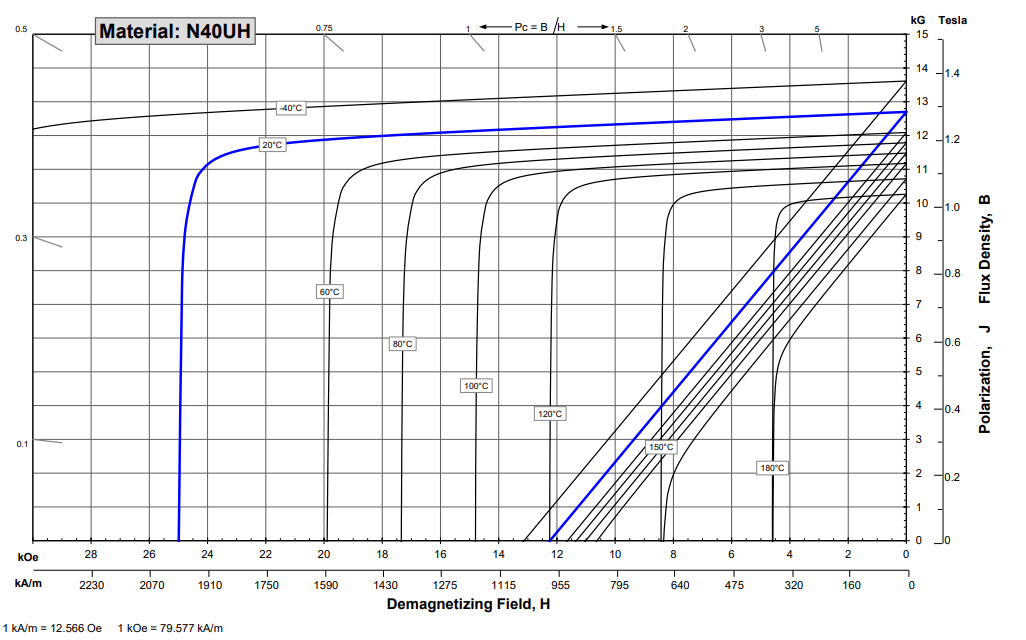
N40UH Neodymium Magnet Performance Curves at Different Temperatures
Recommendations for Using N40UH NdFeB Magnets in Real Applications
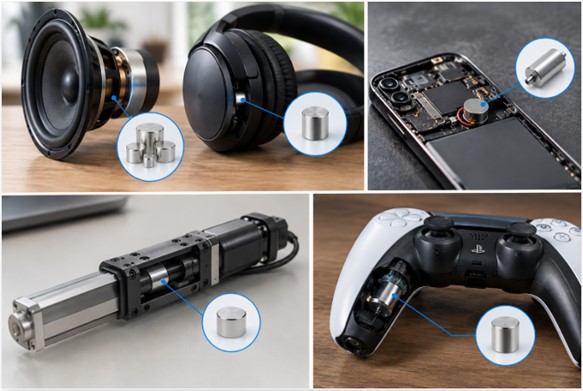
In general, the material N40UH can be used in cases where permanent magnets are required to have a high energy product as well as good resistance to demagnetization; such applications include high-end motors, industrial drive systems, and some magnet assemblies working at higher-than-normal temperatures.
For the case of designing motors, one also needs to estimate the maximum operating temperature, loading, presence of an opposite magnetic field, size of the magnet, and its cooling system. If the equipment works in a high-temperature regime continuously, it is necessary first to check the demagnetization curves at the operating temperature and ensure that there is sufficient margin of demagnetization under the worst-case scenario.
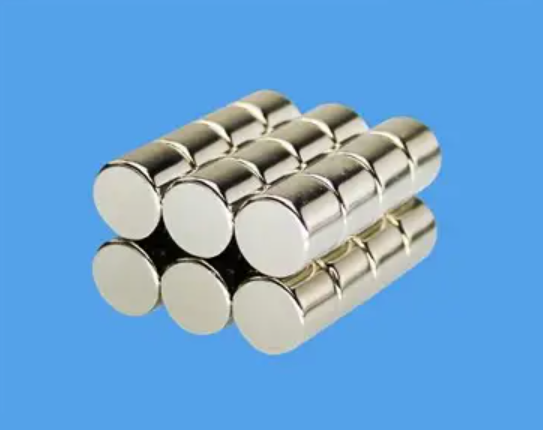
Many types of N40UH NdFeB Magnets are available on request or can be machined from stock sizes.
|
|
|
|
|
|
|
|
|
|
|
|
|
|