

What Factors Should You Consider When Customizing Strong Magnets?
Custom magnets enable a range of shapes, sizes, grades, and magnetization directions that standard products cannot accommodate. Stanford Magnets not only supplies standard magnets in bulk but also offers custom high-strength magnets. Whether you require a complex multi-pole assembly or a standard magnet that is not currently in stock, Stanford Magnets can manufacture permanent magnets to your exact specifications within a few weeks.
Choose the Right Magnet Material for Your Needs
What Materials Are Available?
There are four basic types of permanent magnetic materials, each with distinct characteristics and applications.
- Neodymium (NdFeB): It's the most powerful permanent magnet material with an energy product that exceeds 50 MGOe. And it is ideal for applications requiring a large magnetic field in a compact package, including motor systems, headphones, and sensors.
- Samarium Cobalt (SmCo): Less powerful than Neodymium, but with a high temperature capability range of 250-350°C. Extremely corrosion-resistant, making coating unnecessary.
- Alnico (AlNiCo): The least powerful permanent magnetic material. However, it can perform effectively at high temperatures (550°C). Its mechanical properties make it suitable for industrial applications.
- Ceramic (Ferrite): Least powerful permanent magnetic material. Cheapest of all the types, highly corrosion resistant, and functional even at high temperatures (250°C). Suitable for loudspeakers, magnetic door locks, toys, etc.
Neodymium (NdFeB) Properties & Grades
Since more customers tend to custom-order neodymium magnets, we've put together some extra details on their properties and common grades.
Neodymium (NdFeB) is currently the strongest permanent magnet material available. Its main composition includes neodymium (Nd, 29-32%), iron (Fe, 64.2-68.5%), and boron (B, 1.0-1.2%), with additional elements like aluminum, niobium, and dysprosium added to improve coercivity and corrosion resistance. Key physical properties are below:
|
Property |
Value |
|
Density |
7.5 g/cm³ |
|
Vickers Hardness |
570 D.P.N. |
|
Compressive Strength |
780 N/mm² |
|
Tensile Strength |
8 kg/mm² |
|
Bending Strength |
9.8 × 10⁻¹² m²/N |
|
Curie Temperature |
310°C |
|
Electrical Resistivity |
150 µΩ·cm |
|
Thermal Conductivity |
7.7 kCal/(m·h·°C) |
Neodymium magnets come in many grades, and different grades vary significantly in remanence, coercivity, and maximum operating temperature. Here are the temperature characteristics of common grades:
|
Grade Suffix |
Temp. Coef. of Remanence (α, %/°C) |
Temp. Coef. of Coercivity (β, %/°C) |
Max Operating Temp |
|
(no suffix) |
-0.12 |
-0.60 |
80°C (60°C for N50/N52) |
|
M |
-0.12 |
-0.58 |
100°C |
|
H |
-0.11 |
-0.58 |
120°C |
|
SH |
-0.10 |
-0.55 |
150°C |
|
UH |
-0.09 |
-0.52 |
180°C |
|
EH |
-0.085 |
-0.50 |
200°C |
|
VH/AH |
-0.08 |
-0.45 |
230°C |
Know the Key Magnetic Parameters for Your Custom Magnet
When customizing a magnet, you'll need to specify the core magnetic performance parameters.
- Remanence (Br): The surface magnetic field the magnet can provide. This determines the pull force or the strength of the magnetic field in an air gap.
- Coercivity (Hc) and Intrinsic Coercivity (Hcj): The ability to resist demagnetization from external magnetic fields and high temperatures. For high-temperature environments, you must choose a grade with high Hcj (like SH, UH, or EH).
- Maximum Energy Product (BHmax): The magnetic energy density stored per unit volume. This directly affects how big your magnet needs to be.
Don't just blindly go for the highest grade. Based on your actual operating temperature, reverse magnetic field strength, and required surface field, pick a grade that meets your needs with a 10-20% safety margin—that'll help keep costs under control.
Understand What Dimensions Your Custom Magnet Needs
Dimensions directly affect manufacturability and cost. The two things to pay most attention to are the smallest dimension and the tolerances. Generally speaking, the standard dimensional tolerance is ±0.1mm. Tighter tolerances (like ±0.05mm) are possible but will increase cost. And tighter tolerances aren't always achievable—it depends on the shape and size of the magnet.
Whenever possible, go with looser tolerances that still work for your assembly. Every time you cut a tolerance in half, the machining cost can go up by a lot.
Not sure what size you need? This calculator can help you estimate the magnetic force for custom dimensions. → The Stanford Magnet Calculator
Choose the Right Shape for Your Custom Magnet
Standard shapes like discs, blocks, rings, and cylinders offer the lowest cost and fastest lead times.
What Shapes Can Stanford Magnets Customize?
Here are some shapes we've already custom-made for customers:
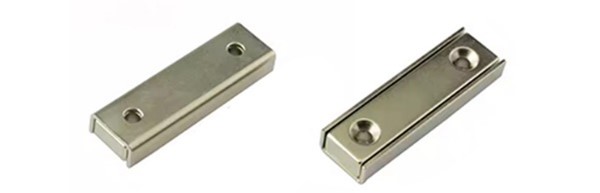
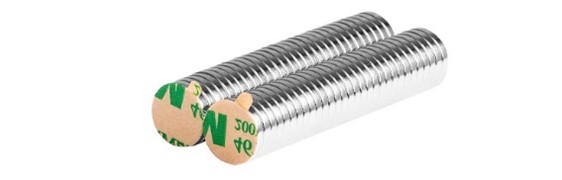
Rectangular Mounting Magnets 3M Adhesive Backing Magnets
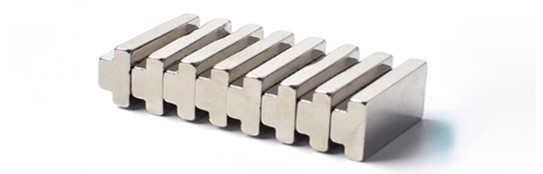
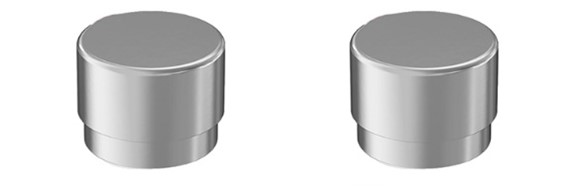
Stepped Magnets Press-Fit Encased Magnets
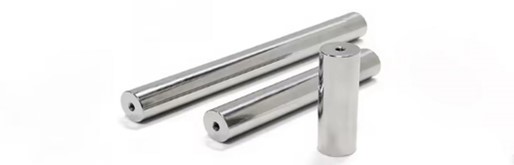
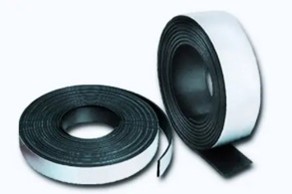
Electric Lifting Magnets Flexible Magnets
Beyond these shapes, Stanford Magnets also accepts requests for other custom magnet shapes. Just provide a clear 2D drawing or 3D model with key dimensions marked.
Does Your Custom Magnet Need a Protective Coating?
Neodymium magnets rust very easily. In humid environments, they'll corrode and lose magnetic performance, so a protective coating is strongly recommended. The standard coating is nickel-copper-nickel (Ni-Cu-Ni), about 15-35 microns thick. Other coating options include:
|
Coating Type |
Best For |
Features |
|
Ni-Cu-Ni (standard) |
General industrial, motors, consumer electronics |
Good value, solid protection |
|
Epoxy |
Humid, salt spray, outdoor environments |
Better corrosion resistance |
|
Zinc |
Indoor, low-cost applications |
Moderate protection |
|
Gold, Silver, Tin |
Special conductivity or appearance needs |
High cost, specific uses |
|
Titanium, TiN (Titanium Nitride) |
High wear resistance, biocompatibility |
Specialized engineering applications |
|
Parylene C, Everlube |
Medical, precision instruments |
Very thin and uniform |
|
PTFE (Teflon) |
Low-friction needs |
Provides a lubricated surface |
|
Rubber coating |
Anti-slip, shock absorption |
Adds extra protection |
|
No coating (bare magnet) |
Not recommended unless requested |
Corrodes very easily |
Magnetization Direction: A Design Factor You Can't Ignore
Magnetization direction is an often-overlooked but critical parameter for custom magnets. Neodymium is an anisotropic magnet, which means it only achieves its best magnetic performance in a specific orientation direction. Common magnetization directions include:
|
Magnetization Type |
Description |
Suitable Shapes |
|
Axial |
Poles are on the two round faces of a disc or cylinder |
Disc, cylinder, ring |
|
Thickness-direction |
Along the smallest dimension of the magnet (common for blocks) |
Block |
|
Diametral |
N and S poles are on opposite sides of the diameter |
Ring |
|
Radial |
Poles are on the inner and outer surfaces of a ring |
Ring |
|
Planar multi-pole |
Multiple N/S poles on a single surface |
Ring, disc |
On top of that, sintered neodymium rings can be multi-pole magnetized, meaning multiple north and south poles on one surface. This is used in encoders, stepper motors, and similar applications.
Magnetization direction must be determined before production starts, because it's tied directly to the orientation process during pressing. Make sure to clearly mark the magnetization direction on your drawing—otherwise, the magnet may not be magnetizable later, or its performance might fall short.
FAQ about Customizing Strong Magnets
1. What's the minimum order quantity (MOQ) for custom magnets?
We don’t have a strict MOQ. The per-piece cost of a small quantity (below 100 pieces) would be higher compared with a large quantity (above 1000 pieces). It is recommended that you provide us with your estimated annual usage so that we can provide you with an optimal quotation.
2. What drawings or information do I need to provide?
In general, the following information is required: material grade, dimension tolerance drawing, magnetization direction, plating/coating type, working temperature range, etc. If you are not sure what material grade to use, just provide your practical working conditions (temperature, environment, and pull force requirement), and we can help you choose.
3. Where does the cost of custom magnets mainly come from?
There are three aspects of expense: ① cost of material, ② cost of machining, and ③ cost of tooling or mold. High-volume purchases will evenly distribute the cost of tooling and machining, making the unit price reduced greatly.
4. Will magnets demagnetize during shipping?
Not necessarily. The magnets cannot be demagnetized without being exposed to very high temperatures or a reversed magnetic field. On the contrary, the magnets, especially the strong magnets such as neodymium magnets, may shatter or spark during shipping. So, we always pack the magnets with nonmagnetic packing or unmagnetized so that customers can magnetize themselves when needed.
5. Can you make multi-pole magnetization?
Absolutely yes. Whatever type of multi-pole, such as axial multi-pole, radial multi-pole, or planar multi-pole, like an encoder ring, we can accomplish that.
6. Can neodymium magnets be used underwater or outdoors?
The nickel, copper, and nickel-coated coating offers some resistance, but not water resistance. When using in an environment of underwater, outdoors, or high humidity, we would suggest epoxy coating, rubber coating, or another better coating material. Otherwise, the magnet would rust and affect its performance.
7. What's the difference between isotropic and anisotropic magnets?
Isotropic magnets have the same magnetic performance in any direction—you can magnetize them in any direction, but performance is lower. Anisotropic magnets only achieve their best performance in one specific direction, called the "orientation direction." Sintered neodymium is typically anisotropic. You must specify the orientation direction when customizing, otherwise the magnet may perform much worse than expected after magnetization.
Summary
Before starting a custom magnet project, we recommend putting together a requirements list that includes: operating temperature, corrosive environment, assembly space drawing with dimensions, required pull force or magnetic field strength, and estimated quantity. This list will help Stanford Magnets quickly provide an accurate solution and quote, avoiding back-and-forth and missing information.