

Hard Ferrite vs Soft Ferrite: Key Differences and Uses
Ferrite materials are among the most widely used magnetic materials in modern industry and electronics. Although they are often discussed as a single category, ferrites actually fall into two fundamentally different classes: hard ferrites and soft ferrites. These materials share a common ceramic chemistry based on iron oxides, yet their magnetic behavior, performance parameters, and applications differ so strongly that they are rarely interchangeable.
The Main Types of Ferrite Materials
Ferrites are electrical insulators used to create magnetic ceramics, which are formed by combining iron oxide, Fe₂O₃, with other metal oxides. The basic distinction in hard and soft ferrites is the response of their magnetic domain to the externally applied magnetic field.
Hard ferrites are seen to be magnetized permanently, whereas soft ferrites can be controlled to be completely reversible to changing magnetic fields with minimal loss of energy. These two characteristics can be measured by parameters like coercivity, remanence, permeability, and hysteresis loss.
Hard Ferrite – Permanent Magnetic Materials
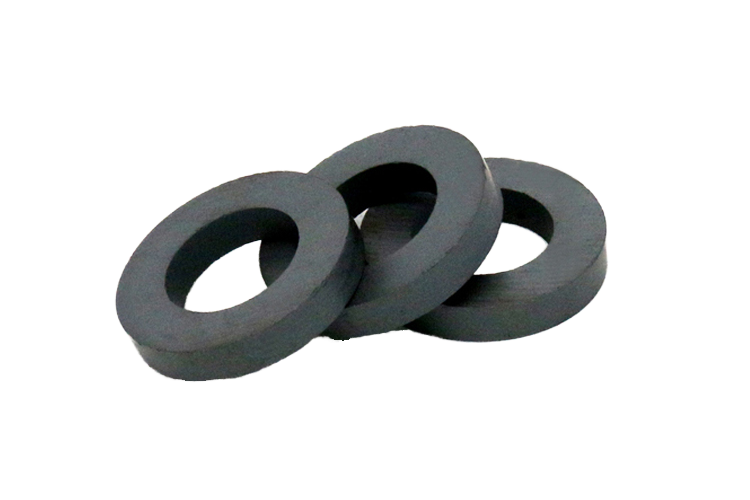
Hard ferrite magnets, otherwise known as ceramic permanent magnets, have high coercive force and ability to resist demagnetization. Typical coercivity of hard ferrite magnets varies from 160 to 300 kA/m. As a result, the magnetic field can be sustained regardless of external magnetic fields acting against them.
Strontium ferrite and barium ferrite, or BaFe₁₂O₁₉, are the most common hard ferrite compositions. Of these, strontium ferrite is the main material in modern ferrite production because of its better remanent flux density and stability to temperature changes. Remanence of hard ferrites usually varies from 0.2 to 0.4 T, though it is less than that of rare-earth materials.
From a processing point of view, hard ferrites are made using a powder pressing/sintering route, where temperatures of over 1,200 °C are involved in processing. During this processing, a magnetic field can be applied, resulting in anisotropic materials with better directional properties. It has hard, brittle, and corrosion-resistant properties, with no need for protective coating.
Hard ferrites are commonly used for applications such as electric motors, loudspeakers, magnetic separators, sensors, and car components. The biggest advantage that hard ferrites enjoy can be attributed to their pricing. In reality, their magnetic strength is not exceptionally high compared to that of a Neodymium magnet.
Soft Ferrite – Functional Magnetic Materials
Soft ferrites have an entirely different application. They are designed to magnetize and demagnetize as quickly and with as little energy loss as possible. This is characterized by their low coercivity of less than 100 A/m. Additionally, they have extremely high magnetic permeability, exceeding 10,000.
There are two main types of soft ferrites: Manganese Zinc (MnZn) ferrites and Nickel Zinc (NiZn) ferrites. Manganese Zinc ferrites are used for frequencies up to a few hundred kilohertz, and they have very high permeability values. Electrical resistivity values for the ferrite material make the Nickel Zinc ferrite the choice for high frequency, typically tens of megahertz.
One of the hallmarks of soft ferrites is their high resistivity, often in excess of 10⁶ Ω·cm. This greatly minimizes eddy current losses, as these are proportional to their electrical conductivity in metallic magnetic materials. This makes soft ferrites vital in all applications involving an alternating magnetic field.
Usually, they are used for transformer cores, inductors, chokes, EMI suppressors, power electronics, etc. In all these applications, energy efficiency and temperature management have to be carefully carried out by reducing hysteresis and eddy current losses, which is where these ferrites are best employed.
Magnetic Behavior and Energy Losses
The distinction between both hard and soft ferrites is mostly visible when the hysteresis curves of the compounds are analyzed. In the case of hard ferrites, the hysteresis curves are very wide, allowing energy retention and resistance to de-magnetization. The properties are desirable for permanent magnets but undesirable for AC applications due to the energy loss that occurs.
On the other hand, soft ferrite magnets have narrow hysteresis curves. This feature ensures that very little energy is lost in repeated magnetization cycles. As a result, these magnets can improve the efficiency of transformers and inductors by reducing heat generated.
From a system design perspective, this difference is critical. If hard ferrite were to be employed in an AC circuit, high losses and overheating will be experienced. Similarly, using a soft ferrite where a permanent magnetic field is required will yield no useful output even with the application of an external field.
Table 1: Comparison of Hard and Soft Ferrite Materials
|
Property |
Hard Ferrite |
Soft Ferrite |
|
Typical Coercivity |
160–300 kA/m |
< 100 A/m |
|
Remanence |
0.2–0.4 T |
Near zero |
|
Magnetic Permeability |
Low (10–100) |
High (1,000–10,000+) |
|
Electrical Resistivity |
High |
Very high |
|
Hysteresis Loss |
High |
Very low |
|
Main Function |
Permanent magnet |
Magnetic field control |
|
Common Compositions |
SrFe₁₂O₁₉, BaFe₁₂O₁₉ |
MnZn, NiZn ferrites |
|
Typical Applications |
Motors, speakers, sensors |
Transformers, inductors, EMI filters |
For more information, please check Stanford Magnets.
Temperature Stability and Environmental Performance
Both hard and soft ferrites offer good thermal and environmental stability compared to metallic magnetic materials. Hard ferrites typically operate reliably up to 250–300 °C, although magnetic strength decreases gradually with temperature. Soft ferrites are more sensitive to temperature changes, particularly in terms of permeability and loss characteristics, which must be considered during power electronics design.
Their ceramic nature makes both types highly resistant to corrosion, oxidation, and chemical attack, an advantage in automotive, industrial, and outdoor environments.
Final Perspective
Hard ferrite and soft ferrite materials represent two distinct solutions to two very different magnetic problems. Hard ferrites provide stable, permanent magnetic fields at low cost and high durability, while soft ferrites enable efficient, low-loss control of alternating magnetic fields in electronic systems.