

Magnet Selection Guide for Medical Magnetic Navigation Brackets
When it comes to designing medical devices, picking the right magnet for a magnetic navigation bracket is a classic multi-objective decision problem. You've got four factors pulling in different directions—performance, safety, cost, and lifespan—and which one takes priority depends entirely on your specific use case.
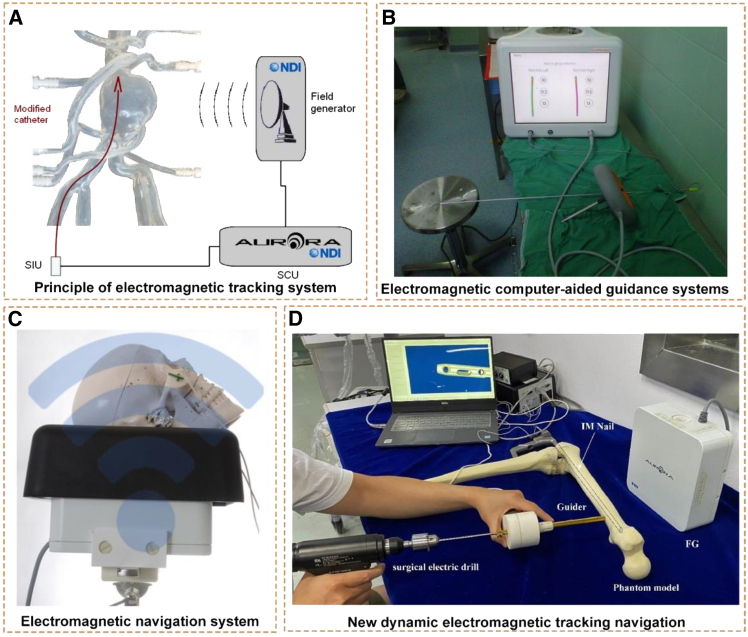
Electromagnetic navigation technology[i]
3 Questions That Nail Down Your Material Direction
Based on our years of sales experience, before you even ask for a quote or dig through technical specs, answer these three questions. They'll determine about 80% of your material direction—the rest you can sort out as you go.
Question #1: Is your bracket reusable or single-use? What sterilization method are you using?
This is the biggest variable by far. Different sterilization methods put very different demands on magnets in terms of temperature and corrosion. If your bracket needs to go through an autoclave at 134°C, a standard neodymium magnet (N-series) will lose a chunk of its strength after just one cycle—we're talking a 20%+ drop in pull force. So this answer immediately narrows you down to either "high-temperature neodymium" or "samarium-cobalt"—standard off-the-shelf magnets are off the table.
Question #2: How much pull force do you need at the working end? How much room do you have for the magnet?
Your force requirement determines the size and grade of the magnet. If space is tight and you need strong force, neodymium is pretty much your only choice—it packs the highest magnetic energy per volume. If you've got room to spare or don't need that much force, you can consider samarium-cobalt, which has better thermal stability and corrosion resistance, even though its magnetic performance is only about 75–80% of neodymium's.
Question #3: Will the bracket be used near an MRI machine?
If yes, your whole selection logic changes. Regular neodymium in an MRI's strong magnetic field will experience serious torque and mess up the images big time. You'll need special low-susceptibility magnets, which are usually custom-engineered—standard options won't cut it.
Pick Your Magnet Category Based on Sterilization Method
Let's break down the answers to Question #1 into three clear scenarios.
Scenario A: Single-use bracket, or sterilized with low-temperature plasma or ethylene oxide (EtO)
This is the simplest case. Both low-temperature plasma and EtO operate below 50°C, so the magnet doesn't face thermal shock or high-temperature demagnetization. Go straight to sintered neodymium N-series high grades—N48, N50, or N52.
Here's why: single-use brackets are cost-sensitive. Neodymium has 1.3 times the energy product of samarium-cobalt for the same volume, so you can hit your force target with a smaller magnet, which keeps the overall bracket size down. Plus, single-use means you don't have to worry about cumulative stress from repeated sterilization cycles—the coating just needs to hold up during storage and shipping before use.
- Recommended grades: N48, N50, N52
- Key specs to watch: Remanence (Br) meeting the grade spec, dimensional tolerances tight enough for assembly
- Coating: Ni-Cu-Ni (15–25 μm thick), passing 24-hour neutral salt spray test
- Typical applications: Single-use puncture positioning brackets, low-cost surgical guides
Scenario B: Reusable, sterilized with high-temperature steam autoclave (134°C)
This is the most common medical scenario—and the one where people mess up the most. Steam sterilization hits magnets with a double whammy: thermal shock that can cause irreversible demagnetization, and a hot, humid environment that can eat through coatings and cause the magnet to crumble.
You've got two options here, each with pros and cons.
Option B1: High-temperature sintered neodymium (UH or EH series). The upside: magnetic performance stays high (Br around 1.1–1.3T), so you don't need to increase magnet size to maintain adequate pull force. The downside: it's heavily dependent on coating quality. If the coating develops pinholes or cracks after repeated sterilization, corrosion will spread along grain boundaries, causing the magnet to swell and lose performance permanently. If you go this route, coating quality is the factor that determines lifespan. We recommend Ni-Cu-Ni plus an epoxy topcoat, total thickness no less than 30 μm, validated by 96+ hours of neutral salt spray testing.
Option B2: Samarium-cobalt (SmCo28 or SmCo30). The upside: excellent chemical stability—no coating needed even in hot, humid conditions—and an operating temperature up to 300°C, which eliminates both thermal demagnetization and corrosion risks. The downside: lower magnetic performance (Br around 1.0–1.1T), so you'll need about 20–30% more magnet volume to get the same pull force, and material cost is roughly 3–5 times that of neodymium.
So which one do you pick? It comes down to your bracket's space constraints and expected lifespan. If you're tight on space and can't fit a bigger magnet—and your budget is limited—go with Option B1 and be meticulous about coating quality; it should get you through 100 sterilization cycles. If you have room to spare, or you need 500+ cycles of reliable performance, or you just don't want to worry about coating failure, Option B2 is the safer bet.
- Recommended grades: N42UH / N38EH (Option B1); SmCo28 / SmCo30 (Option B2)
- Key specs to watch: Hcj ≥ 1990 kA/m (UH) or ≥ 2388 kA/m (EH); irreversible magnetic loss < 3% after 2 hours at 134°C
- Critical validation: Coating adhesion (cross-hatch test), visual inspection and flux change after 100 sterilization cycles
- Typical applications: Reusable laparoscopic instrument holders, general-purpose surgical navigation arms
Scenario C: MRI environment or strong magnetic field area
When your bracket needs to work near or inside an MRI room, both regular neodymium and samarium-cobalt run into special problems. MRI's superconducting magnetic field can hit 1.5–3T, which exerts huge torque on conventional magnets—if not secured properly, they can move dangerously. Plus, the magnet's own susceptibility messes with the MRI's field uniformity, causing major image artifacts.
This scenario calls for magnets with extremely low susceptibility. You're usually looking at specially formulated low-susceptibility samarium-cobalt or alnico magnets, paired with a Permalloy shield to contain stray magnetic fields within a tiny area. There are no standard off-the-shelf products for this—it's basically a custom development project. You'll need to work with your magnet supplier to design the magnetic circuit and run MRI compatibility testing. If your project falls into this bucket, reach out to a supplier with medical magnet experience early on—don't try to figure it out on your own.
Pin Down the Specific Magnet Grade Based on Pull Force
Once you've settled on the magnet family, you need to pick the right grade within that family. Grade selection comes down to the pull force you need and the space you have.
For neodymium, the higher the number in the grade, the higher the remanence. N52 has a Br around 1.43–1.45T, while N42 is around 1.25–1.32T—that's roughly a 15–20% difference in pull force for the same size. Going with a higher grade gets you more force without increasing magnet size, but it also costs more. As a rule of thumb, start with N48 or N50 as your baseline. If you need more force, step up to N52. If you have plenty of room and the force requirement is modest, drop down to N42 to save on material costs.
For samarium-cobalt, the number after the grade also reflects the energy product level. SmCo28 has a Br around 1.02–1.08T, and SmCo30 is around 1.08–1.12T. Since samarium-cobalt is inherently weaker than neodymium, going with a higher grade helps close the volume gap when you're aiming for a specific pull force.
For actual sizing, start with this simplified estimate of the minimum magnet volume you'll need:
Required magnetic flux ≈ pull force (N) ÷ air gap flux density (T)
Air gap flux density is usually 30–50% of the magnet's remanence, depending on how closed the magnetic circuit is.
Example: if you need about 5N of pull force at the working end, and you estimate the air gap flux density at 0.5T, you'll need roughly 10 cm² of effective magnetic flux area. From there you can figure out the magnet's cross-section dimensions. If that size exceeds what your bracket can accommodate, you'll need to go to a higher grade or switch to neodymium for higher remanence.
Quick Reference Decision Table
Here's a summary of the whole selection logic in one table. Just find the row that matches your situation.
|
Use Case |
Recommended Material |
Key Specs |
Coating & Protection |
|
Single-use, room temperature |
N48 / N50 / N52 |
Br ≥ 1.38T, tolerance ±0.05mm |
Ni-Cu-Ni 15–25μm, salt spray 24h |
|
Reusable, steam sterilization, tight space |
N42UH / N38EH |
Hcj ≥ 1990kA/m, <3% loss at 134°C |
Ni-Cu-Ni + epoxy, salt spray 96h |
|
Reusable, steam sterilization, room to spare |
SmCo28 / SmCo30 |
Br 1.0–1.1T, withstands 300°C |
Can be uncoated |
|
MRI environment or strong field |
Low-susceptibility SmCo / Alnico |
Susceptibility test report required |
With Permalloy shield |
Final Thoughts
Picking the right magnet for a medical magnetic navigation bracket doesn't have to be an overwhelming, cover-all-bases engineering exercise. Just get clear on three variables—sterilization method, pull force requirement, and operating environment—and your options shrink fast. For everyday surgical brackets, N-series neodymium works for single-use or low-temperature sterilization; UH/EH high-temp neodymium and samarium-cobalt split the reusable space between compact designs and reliability-first applications; and low-susceptibility custom grades handle MRI-compatible needs.
With over a decade of sales experience, Stanford Magnets has developed extensive expertise in standard magnets, custom designs, and magnetic assemblies. If you have any other questions about magnet selection, don't hesitate to reach out. GET A QUOTE