

The Complete Guide to Neodymium Magnets
Neodymium magnets, also known as NdFeB magnets, are tetragonal crystalline crystals made from neodymium, iron, and boron (Nd₂Fe₁₄B). They were first discovered in 1982. These magnets have a maximum energy product (BHmax) greater than samarium‑cobalt magnets, making them the material with the highest magnetic energy product in the world at the time. Later, General Motors successfully developed a melt‑spinning process that could produce neodymium‑iron‑boron magnets. Today, these magnets are the strongest permanent magnets available, second only to holmium magnets at absolute zero, and they are the most commonly used rare‑earth magnets. NdFeB magnets are widely used in electronic products such as hard drives, mobile phones, headphones, and battery‑powered tools.
Chemical Composition of Neodymium Magnets
NdFeB permanent magnetic materials are based on the intermetallic compound Nd₂Fe₁₄B. The main components are rare‑earth elements, iron (Fe), and boron (B). The primary rare‑earth element is neodymium (Nd), but part of it can be substituted with other rare‑earth metals like dysprosium (Dy) or praseodymium (Pr) to achieve different performance characteristics. Iron can also be partially replaced by other metals such as cobalt (Co) or aluminum (Al). Although boron makes up only a small fraction of the composition, it plays a critical role in forming the tetragonal crystalline structure of the intermetallic compound, which gives the material its high saturation magnetization, strong uniaxial anisotropy, and high Curie temperature.
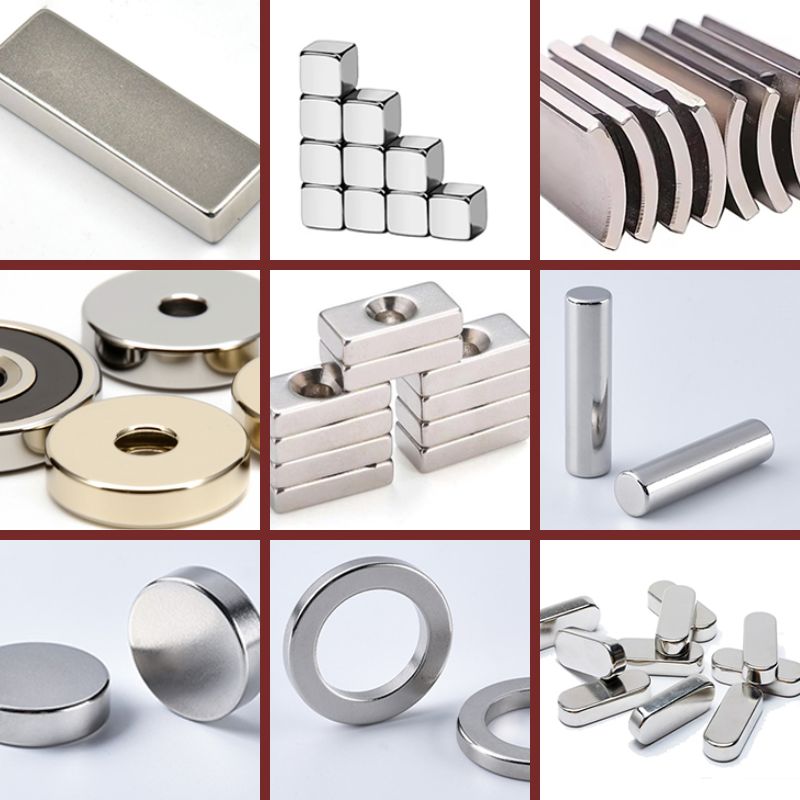
Fig 1. Different shapes of Neodymium Magnets
The Strong Magnetism of Neodymium Magnets
Pure neodymium is antiferromagnetic below 19 K, but the Nd₂Fe₁₄B compound formed with iron and boron exhibits strong ferromagnetism at room temperature, which forms the basis for NdFeB magnets. The high performance of these magnets mainly comes from the strong uniaxial magnetocrystalline anisotropy (Hₐ ≈ 7 T) of their tetragonal structure, which makes the crystals easy to magnetize along a specific axis and resistant to deviating from it. During manufacturing, the microcrystalline grains are aligned in a magnetic field to create a uniform magnetic axis, and the lattice's resistance to magnetization direction changes gives the material its exceptionally high coercivity.
In addition, neodymium atoms have four unpaired electrons whose spins align to generate a strong magnetic field, giving Nd₂Fe₁₄B its high saturation magnetization (Jₛ ≈ 1.6 T) and high remanence (about 1.3 T). Since the maximum energy product is proportional to Jₛ², this material can achieve magnetic energy storage of up to 512 kJ/m³.
Neodymium magnets have about 18 times the magnetic energy per unit volume and 12 times the magnetic energy per unit mass of ordinary ferrite magnets. The energy product of NdFeB alloys is higher than that of the earlier commercially available samarium‑cobalt magnets. In practical applications, the magnetic properties of neodymium magnets depend on the alloy composition, microstructure, and manufacturing process.
The Nd₂Fe₁₄B crystal structure can be described as alternating layers of iron atoms and neodymium‑boron layers. The diamagnetic boron atoms do not directly contribute to magnetism, but they enhance structural cohesion through strong covalent bonds.
Table 1. Physical Property Comparison of Neodymium Magnets and Samarium‑Cobalt Magnets
|
Property |
Neodymium Magnet |
Samarium‑Cobalt Magnet |
|
Remanence (T) |
1.0 – 1.5 |
0.8 – 1.16 |
|
Coercivity (MA/m) |
0.875 – 2.79 |
0.493 – 2.79 |
|
Recoil Permeability |
1.05 |
1.05 – 1.1 |
|
Temp. Coefficient of Br (%/K) |
-(0.12 – 0.09) |
-(0.05 – 0.03) |
|
Temp. Coefficient of Hcj (%/K) |
-(0.65 – 0.40) |
-(0.30 – 0.15) |
|
Curie Temperature (°C) |
310 – 370 |
700 – 850 |
|
Density (g/cm³) |
7.3 – 7.7 |
8.2 – 8.5 |
|
CTE Parallel to Magnetization (1/K) |
(3 – 4) × 10⁻⁶ |
(5 – 9) × 10⁻⁶ |
|
CTE Perpendicular to Magnetization (1/K) |
(1 – 3) × 10⁻⁶ |
(10 – 13) × 10⁻⁶ |
|
Bending Strength (N/mm²) |
200 – 400 |
150 – 180 |
|
Compressive Strength (N/mm²) |
1000 – 1100 |
800 – 1000 |
|
Tensile Strength (N/mm²) |
80 – 90 |
35 – 40 |
|
Vickers Hardness (HV) |
500 – 650 |
400 – 650 |
|
Resistivity (Ω·cm) |
(110 – 170) × 10⁻⁶ |
(50 – 90) × 10⁻⁶ |
Table 2. Main Grades and Magnetic Performance Parameters of NdFeB Permanent Magnetic Materials
|
Grade |
Br mT (kG) |
bHc kA/m (kOe) |
iHc kA/m (kOe) |
(BH)max kJ/m³ (MGOe) |
Max. Operating Temp. (°C) |
|
N35 |
1170-1210 (11.7-12.1) |
≥868 (≥10.9) |
≥955 (≥12) |
263-287 (33-36) |
80 |
|
N38 |
1210-1250 (12.1-12.5) |
≥899 (≥11.3) |
≥955 (≥12) |
287-310 (36-39) |
80 |
|
N40 |
1250-1280 (12.5-12.8) |
≥923 (≥11.6) |
≥955 (≥12) |
318-342 (38-41) |
80 |
|
N42 |
1280-1320 (12.8-13.2) |
≥923 (≥11.6) |
≥955 (≥12) |
318-342 (38-41) |
80 |
|
N45 |
1320-1380 (13.2-13.8) |
≥876 (≥11.0) |
≥955 (≥12) |
342-366 (43-46) |
80 |
|
N48 |
1380-1420 (13.8-14.2) |
≥835 (≥10.5) |
≥876 (≥11) |
366-390 (46-49) |
80 |
|
N33H |
1130-1170 (11.3-11.7) |
≥836 (≥10.5) |
≥1353 (≥17) |
247-241 (31-34) |
120 |
|
N35H |
1170-1210 (11.7-12.1) |
≥868 (≥10.9) |
≥1353 (≥17) |
263-287 (33-36) |
120 |
|
N38H |
1210-1250 (12.1-12.5) |
≥899 (≥11.3) |
≥1353 (≥17) |
287-310 (36-39) |
120 |
|
N40H |
1240-1280 (12.4-12.8) |
≥923 (≥11.6) |
≥1353 (≥17) |
302-326 (38-41) |
120 |
|
N42H |
1280-1320 (12.8-13.2) |
≥955 (≥12.0) |
≥1353 (≥17) |
318-342 (40-43) |
120 |
|
N45H |
1320-1360 (13.2-13.6) |
≥955 (≥12.0) |
≥1353 (≥17) |
342-366 (43-46) |
120 |
|
N33SH |
1130-1170 (11.3-11.7) |
≥844 (≥10.6) |
≥1592 (≥20) |
247-272 (31-34) |
150 |
|
N35SH |
1170-1210 (11.7-12.1) |
≥876 (≥11.0) |
≥1592 (≥20) |
263-287 (33-36) |
150 |
|
N38SH |
1210-1250 (12.1-12.5) |
≥907 (≥11.4) |
≥1592 (≥20) |
287-310 (36-39) |
150 |
|
N40SH |
1240-1280 (12.4-12.8) |
≥939 (≥11.8) |
≥1592 (≥20) |
302-326 (38-41) |
150 |
Corrosion Susceptibility of Neodymium Magnets
Sintered Nd₂Fe₁₄B magnets are prone to corrosion, especially along the grain boundaries of the sintered structure. This corrosion can cause serious performance degradation, including the magnet breaking down into fine magnetic particles or surface layer flaking.
Many commercial products address this vulnerability by applying protective coatings to prevent exposure to the atmosphere. Nickel plating, nickel‑copper‑nickel, and zinc plating are standard methods, but other metal plating, polymer coatings, and paint protective layers are also used.
Temperature Sensitivity of Neodymium Magnets
Neodymium magnets have a negative temperature coefficient, meaning their coercivity and maximum energy product (BHmax) decrease as temperature rises. NdFeB magnets have high coercivity at room temperature, but above 100°C, their coercivity drops sharply until they reach the Curie temperature of about 320°C. This reduction in coercivity limits their efficiency in high‑temperature applications such as wind turbines and hybrid vehicle motors. Adding dysprosium or terbium can suppress the performance degradation caused by temperature changes, but it also increases production costs. The temperature dependence of the material's magnetic properties can be characterized through electronic structure calculations using the disordered local moment model.
For comparison, here are the Curie temperatures of various magnet types:
- Ferrite magnets: 465°C
- NdFeB magnets: 320°C – 460°C
- Alnico magnets: 800°C
- Samarium‑Cobalt magnets: 700°C – 800°C
- Iron‑Chromium‑Cobalt magnets: 680°C
Sintered Neodymium Magnets vs. Bonded Neodymium Magnets
Depending on the manufacturing process, NdFeB magnets fall into two categories: sintered and bonded. Bonded NdFeB magnets are isotropic, meaning they are magnetic in all directions, and they have good corrosion resistance on their own. Sintered NdFeB magnets, on the other hand, are more susceptible to corrosion and require electroplating on the surface. Common coatings include zinc plating, nickel plating, environmentally friendly zinc, environmentally friendly nickel, nickel‑copper‑nickel, and environmentally friendly nickel‑copper‑nickel. Sintered NdFeB magnets are anisotropic, and their magnetization direction is typically either axial or radial, depending on the working surface requirements.
Surface treatment options for NdFeB magnets include:
- Nano‑chelated film coating (coating‑free treatment technology)
- Phosphating
- Electroplating
- Electrophoretic coating
- Vacuum deposition
- Electroless plating
- Organic powder spraying
Applications of Neodymium Magnets
Sintered NdFeB permanent magnetic materials have excellent magnetic properties and are widely used in electronics, electric machinery, medical devices, toys, packaging, hardware machinery, aerospace, and many other fields. Common applications include permanent magnet motors, speakers, magnetic separators, computer disk drives, MRI equipment, and instrumentation.
As material performance and surface protection technologies have improved, the operating environment for sintered NdFeB magnets has gradually expanded to include higher humidity and more corrosive conditions. In recent years, new surface treatment processes such as nanoscale chelated film coating‑free treatments have been studied to enhance corrosion resistance and interfacial bond strength, with significant improvements in resistance to heat, humidity, and salt spray. These technologies hold potential for applications in marine environments, wind power equipment, high‑speed permanent magnet motors, electric vehicle motors, specialty motors, aerospace, and defense industries.
Reading more:
How Neodymium Magnets Are Used in the Automotive Industry
How Magnets Are Used in Medicine
Why Neodymium Magnets Are the Go-To Choice for Audio Gear
Everyday Uses of Countersunk Rare Earth Magnets
What Magnets are Used in Everyday Life
The End
Whether you need standard-grade neodymium magnets or custom specifications for specialized applications, Stanford Magnets offers a wide range of options to meet your requirements.